

Bachelor of Science in Diagnostic Medical Sonography
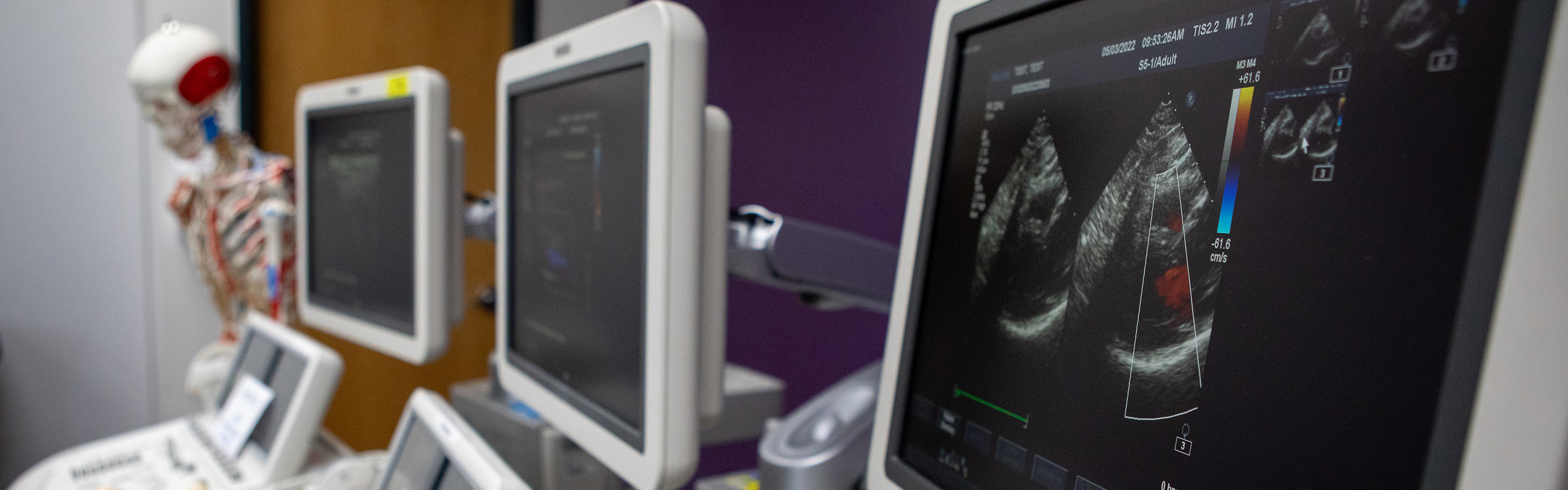
Diagnostic Medical Sonography (DMS) is a multi-specialty profession using high-frequency sound waves (ultrasound) to produce dynamic visual images, often called sonograms, of organs, tissues or blood flow inside the body.
DMS is used in the detection and treatment of heart disease, vascular disease that can lead to stroke and fine-needle tissue guided biopsy procedures to obtain a sample of cells for lab testing.
Students pursuing a Bachelor of Science in Diagnostic Medical Sonography learn anatomy, physiology and pathophysiology, sonography principles and instrumentation, medical ethics, patient education and communication, clinical assessment and evaluation, scanning protocol and safety for diagnostic examination, and more.
Program Prerequisites
Prerequisites can be fulfilled with either:
- Associate of Applied Science or Associate of Science degree (recommended in a medical profession such as nursing or respiratory therapy) and patient care experience
- AAS or AS degree, in a field such as radiography, and ARRT certification
- A bachelor's degree (best if in a medically related major)
Additionally, all students must have completed one of the following sets of science classes, either at Weber State or at another accredited institution, to be eligible to apply.
- HTHS 2110 LS: Integrated Anatomy and Physiology I (4 credits) and HTHS 2111 Integrated Anatomy and Physiology II (4)
- ZOOL 2320 Human Anatomy (4) and ZOOL 2420 LS Human Physiology (4)
Applicants may apply while completing their associate’s degree and/or ARRT certification, but these must be completed before the program start date.
Degree Requirements
Students must complete all required diagnostic medical sonography coursework and general education coursework to earn a Bachelor of Science in Diagnostic Medical Sonography.
Diagnostic medical sonography students are required to pick a specific degree emphasis in the program, either the cardiac emphasis or the medical emphasis.
For all emphases, students are also required to complete 24 hours of clinical education per week in a WSU-affiliated healthcare facility as part of the program.
Diagnostic Medical Sonography (Catalog) General Education Requirements
Degree Emphases
Cardiac Emphasis
Diagnostic cardiac sonographers use ultrasound to image the heart and cardiovascular system. The examinations are performed to aid physicians in diagnosing cardiac pathology and vascular blockage to the heart.
As a cardiac sonographer, you should demonstrate competence through certification in the area of practice by the nationally recognized sonography credentialing organization.
Medical Emphasis
Diagnostic medical sonographers use ultrasound and are specialized to image the abdomen and superficial structures and/or specialized to image gynecologic and obstetric cases. The examinations are performed to aid physicians in diagnosing and evaluating normal and abnormal anatomy as well as disease and pathology.
As a medical sonographer, you should demonstrate competence through certification in the area of practice by the nationally recognized sonography credentialing organization.
Location and Delivery
The Campus Program requires travel to Weber State University’s Ogden Campus in Ogden, Utah for classes once per month.
Campus and Regional programs are completed in four straight semesters, beginning each fall.
Clinical Site Information
Campus Program students residing in Utah are assigned to clinical sites in Utah.
Regional Program students residing outside of Utah must secure their own clinical site.
Certification
Upon completion, students can take the national certification examinations given by the American Registry of Diagnostic Medical Sonographers (ARDMS) and, if needed, American Registry of Radiologic Technologists (ARRT).
Many states require practicing sonographers to be licensed.