

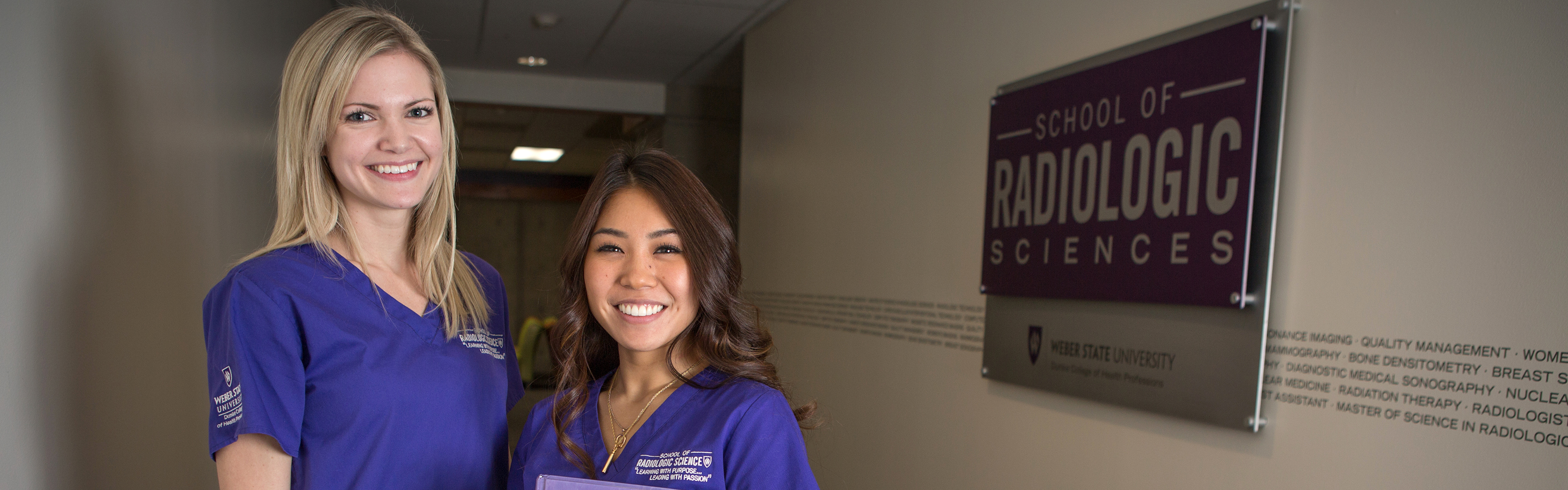
About the School of Radiologic Sciences
The School of Radiologic Sciences offers nearly six decades of educational experience in medical imaging. Our programs combine classroom instruction and clinical practice taught by highly motivated and nationally recognized faculty.
We provide the knowledge and skills you need to work in clinical settings, move up the career ladder and pursue advanced certification.
Accreditation
The American Registry of Radiologic Technologists (ARRT) recognizes Weber State University’s Radiologic Sciences programs as meeting national professional standards.
Weber State is a member of the American Council on Education and the American Association of State Colleges and Universities, and is accredited by the Northwest Commission on Colleges and Universities and the Utah State Board of Regents.
Mission
The School of Radiologic Sciences at Weber State University is dedicated to advancing the radiologic sciences profession by fostering academic excellence, professional growth, and meaningful community engagement. Rooted in values of respect, integrity, and innovation, the program supports students and faculty through collaborative research opportunities, access to advanced technologies, and personalized academic advisement.
We are committed to cultivating an inclusive and supportive learning environment, promoting responsible professional conduct, and preparing graduates to lead in clinical, educational, and research settings.
Goals
Our primary goal is to equip you with the knowledge, skills and judgment needed to render quality healthcare services. Our secondary goal is to broaden your knowledge within the professional discipline and to maintain professional competency through a desire to participate in lifelong learning.
Learning Objectives
To achieve our mission and provide the knowledge, skills, and judgment necessary to render quality care and services, the program is structured around five core pillars of excellence with associated learning objectives.
Patient Care and Education
1.1 Students demonstrate appropriate patient education, safety, and comfort skills
1.2 Students know and use appropriate methods of infection control and prevention
1.3 Students administer contrast and monitor patients
1.4 Students respond to a variety of patient populations
Professional Development and Research
2.1 Students will demonstrate characteristics of professionalism
2.2 Students will act as mentors and leaders, and value strategic planning
2.3 Students will gather literature and evaluate data through professional writing
Clinical Competency and Medical Ethics
3.1 Students will demonstrate legal, professional, and ethical responsibility
3.2 Students will demonstrate clinical competency
Instrumentation and Quality Care
4.1 Students will demonstrate proper safety and technical training
4.2 Students will understand principles of image production
4.3 Students will evaluate images and understand principles of quality control
4.4 Students will accurately interpret quality assurance tests.
Biological Effects and Assessment
5.1 Students will understand and demonstrate principles of patient safety (biological effects and radiation safety, MRI safety, and safe use of MI & TI in sonography
5.2 Students will use appropriate protective measures for themselves and patients
History
1967–1970
Weber State University’s Radiologic Sciences program evolves from two radiography programs conducted by St. Benedict’s Hospital and Dee Memorial Hospital. Students complete general education courses at Weber State College (later WSU), while professional courses are taught at the hospitals.
1969
The Utah Board of Regents assigns Weber State College the primary role for the study of radiologic sciences.
1970
The hospitals give up sponsorship of the radiography programs, and the college assumes responsibility for the programs with all classes taught on campus.
1976
The Utah Board of Regents approves the nuclear medicine and radiation therapy programs.
1980
The Utah Board of Regents approves the diagnostic medical sonography program.
Early 1980s
The Utah Board of Regents approves our baccalaureate degree level in allied health sciences, allowing many of our programs to become educational career ladders for technologists.
1980s
As innovative technological imaging specialties develop, programs in computed tomography, magnetic resonance imaging, cardiovascular interventional technology and advanced radiography are added.
Mid-1980s
Due to campuswide budget cuts, our faculty is faced with possibly discontinuing advanced specialty programs. Rather than ending the programs and leaving the medical community without a manpower source, with the permission of the dean and WSU administration, the programs moved to the Division of Continuing Education.
Early 1990s
A mammography emphasis is added.
2010s
The Master of Science in Radiologic Sciences is created in 2010.
2018
The Department of Radiologic Sciences becomes the School of Radiologic Sciences.