

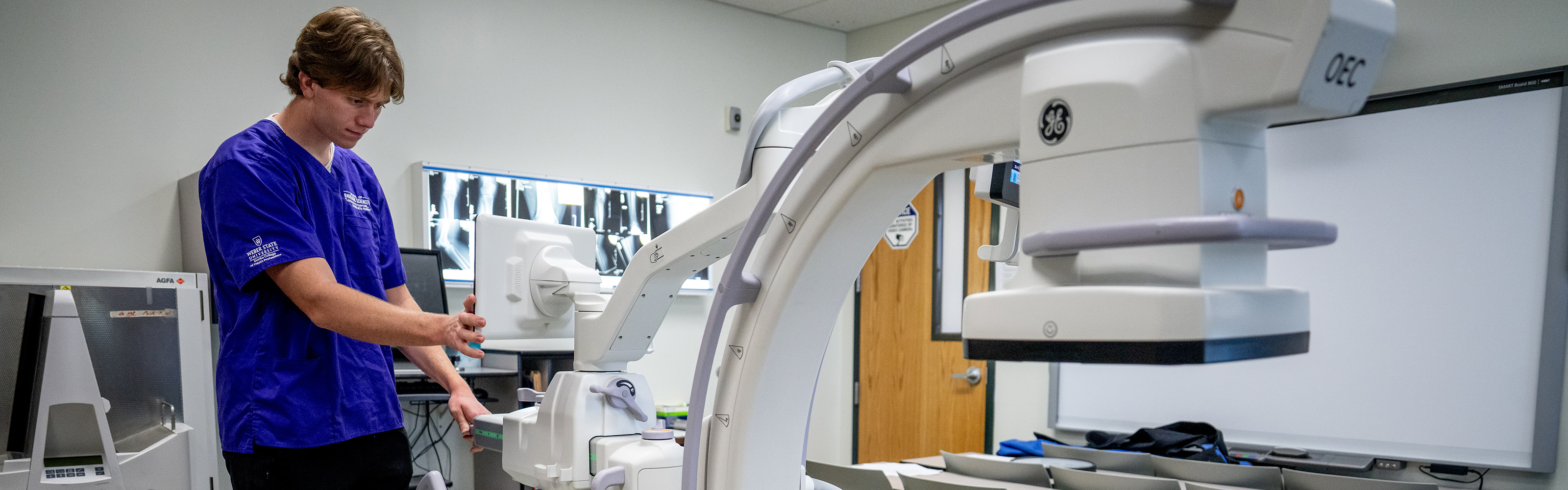
Bachelor of Science in Advanced Radiologic Sciences
The School of Radiologic Sciences’ Bachelor of Science in Advanced Radiologic Sciences offers students seven different emphases to choose from.
Whatever career path you want to take, whether it’s in computed tomography, magnetic resonance imaging, mammography or interventional radiology, our programs will prepare you for your career in radiologic sciences disciplines, technical, management, or educational positions.
Students pursuing the advanced radiologic sciences degree must select an emphasis or a combination of emphases.
Program Prerequisites
All bachelor’s degree emphases, except for the Magnetic Resonance Imaging (MRI) - Primary Pathway emphasis, require the following in order to apply:
- An Associate of Applied Science degree, an Associate of Science degree, or higher
- ARRT certification
Applicants may apply to the program while in progress of completing their associate’s degree and ARRT certification, but these must be completed before the program start date.
Certain degree emphases may have different eligibility requirements.
The MRI - Primary Pathway emphasis has specific prerequisites instead of requiring ARRT certification and an associate’s degree.
Degree Requirements
Students must complete all required radiologic sciences and general education coursework, and, if necessary, clinical education requirements to earn a Bachelor of Science in Advanced Radiologic Sciences.
Most degree emphases require students to complete 24 hours of clinical education per week in a Weber State-affiliated healthcare facility.
Advanced Radiologic Sciences (Catalog) General Education Requirements
Clinical Site Information
Campus program students residing in Utah are assigned to clinical sites in Utah.
Regional program students residing outside of Utah must secure their own clinical site.
Degree Emphases
All degree emphases, except Advanced Radiologic Sciences, require travel once per month to Weber State University’s Ogden campus in Ogden, Utah, for classes.
Degree emphases are completed in three straight semesters except for Computed Tomography (CT), which is completed in two semesters.
-
Advanced Radiologic Sciences
Our Advanced Radiologic Sciences emphasis fills the educational needs for imaging professionals and provides a career ladder for those who wish to obtain additional skills in advanced areas.
You can expect to learn and gain advanced skills in clinical medicine, imaging pathophysiology and research. Advanced radiologic technologists can work as a mid-level supervisor, and apply for graduate school and pre-physician assistant courses of study.
No clinical education is required for this emphasis.
Advanced Radiologic Sciences Emphasis (Catalog)
Advanced Radiologic Sciences Degree Map (Grad Maps app)
Concentrations
PACS Concentration: Picture Archiving and Communications System (PACS) administrators facilitate a complex set of functions to achieve a successful imaging workflow in the radiology environment. Students learn about image management, information technology, systems management, clinical engineering, medical informatics, procurement, and more.
The following courses prepare you to obtain certification through the American Board of Imaging Informatics (ABII.org) to become a certified imaging informatics professional (CIIP). These courses are well suited for radiologic technologists or IT professionals.
- RADT 3563 Managing Clinical Information (3 credits)
- RADT 4433: PACS Administration (3)
- RADT 4443: Imaging Informatics (3)
Locations and Delivery
Campus and Regional programs for this degree can be completed in two straight semesters, beginning each semester.
Independent Study Options
Students can also earn a bachelor's degree in advanced radiologic sciences online through our Independent Study program.
-
Computed Tomography (CT)
Computed Tomography (CT) technologists use a rotating x-ray unit to obtain slices of anatomy at different levels within the body. A computer stacks and assembles the individual slices, creating a diagnostic image.
You’ll learn about interactions of electromagnetic waves, instrumentation, imaging sequences and computer parameters of computerized tomography imaging, computed tomography of the torso and limbs, and computed tomography physics and instrumentation.
As a CT technologist, you can work in a hospital or clinical setting or as a researcher, using experimental protocols and equipment to perform complex exams in a research facility or university.
You may also become a radiology manager, leading a radiology department; a sales associate, selling CT equipment to hospitals and clinics; or an application specialist, teaching others to operate CT machines after they’re purchased from a manufacturer.
-
Interventional Imaging (II)
Technologists working in interventional technology assist interventional radiologists with diagnostic angiographic procedures, complex vascular interventional procedures and therapeutic procedures.
You’ll learn equipment and instrumentation, patient care and interventional procedures, including neurological, thoracic, abdominal, genitourinary, gastrointestinal (nonvascular) and peripheral.
Cardiovascular-interventional radiographers utilize sophisticated imaging practices, which allow vascular procedures to be performed without invasive surgery. You may work in hospitals, clinics, labs and outpatient centers.
-
Magnetic Resonance Imaging (MRI)
Magnetic resonance imaging (MRI) technologists are specially trained to operate magnetic resonance (MR) equipment. An MRI scan is used to produce detailed images of a patient’s anatomy.
You’ll learn physical principles and theories of magnetic resonance, instrumentation, imaging sequences and methods in normal and abnormal tissue, and computer parameters of magnetic resonance, along with advanced MRI procedures and safety and MRI of the central nervous system, torso and limbs.
MRI technologists can work in various areas, including hospitals, clinics, research, universities, management, sales, and teaching clients how to operate MRI machines post purchase.
-
Magnetic Resonance Imaging (MRI) - Primary Pathway
The MRI Primary Pathway program grants the same degree as the MRI emphasis, but the MRI Primary Pathway program is available to students who are not ARRT certified or currently enrolled in an ARRT certification program.
Students must complete a leveling course, RADT 4601: MRI Entry Level-Patient Care and Safety, before starting the program. Students will need to contact rexchristensen@weber.edu or RadBS@weber.edu for instructor approval to register for RADT 4601.
MRI Primary Pathway Prerequisites
- Must have patient care experience
- Must be certified as a Limited Practical Technologist (LPT) before starting the program
-
Mammography
Mammography aids in the early diagnosis of breast cancer. Screening and diagnostic mammography exams are performed by registered mammography technologists.
In the bachelor's degree mammography emphasis, you’ll learn mammography anatomy, physiology, positioning and quality assurance.
Students who complete the mammography program also fulfill the federal requirements for the Mammography Quality Standards Act (MQSA) certification.
This certification is accepted by many states and may be used to fulfill state licensing regulations.
Certification
Upon completion of your emphasis, you can take the national certification examination given by the American Registry of Radiologic Technologists (ARRT).
States often require practicing technologists to be licensed. Utah requires practicing radiologic technologists to be licensed by the state.