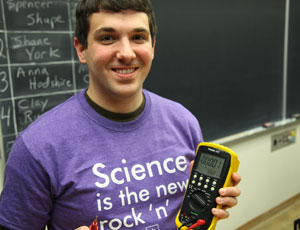
Student Research Opportunities in Physics
In the WSU Physics Department, we encourage all students to get involved in research projects and other independent work. These projects give you an opportunity to work more independently than in a traditional classroom setting, choosing a project to suit your personal interests. They also give you a taste of what scientific research is like, perhaps helping you decide whether to pursue a research-oriented career.
Because we offer no graduate programs, undergraduate physics students have access to all of our department’s research equipment. Mentoring undergraduates is a priority of our faculty.
When should you do research?
It’s never too early to start planning a physics research project! Browse the list of opportunities available on this webpage, and get to know the faculty who work in subfields of physics that interest you. Depending on the project, you may be able to participate even before you have taken a course in physics. In other cases, our faculty can advise you on how to prepare for an early start in physics research.
Getting credit
Many students doing physics research projects obtain academic credit by signing up for PHYS 2800 (lower division) or 4800 (upper division). Students doing independent guided reading projects can obtain credit through PHYS 2830 or 4830. For projects in astronomy, students can obtain credit through ASTR 2800, 2830, 4800, or 4830. All students majoring in Applied Physics must sign up for at least one PHYS 4800 course. Some students ultimately develop their research projects into a Senior Thesis (PHYS 4970). Approval of a faculty mentor is required before signing up for any of these courses.
Getting paid
In some cases, students may obtain a research stipend or scholarship as an alternative to academic credit. Funding comes from a variety of grants and fellowship programs, and may be available for part-time research at any time, or for full-time research during the summer.
Summer research elsewhere
We also encourage WSU physics students to consider summer research internships at other institutions. These internships are typically competitive, but our faculty can advise you on how to put together a strong application. The largest collection of summer research opportunities is the National Science Foundation’s Research Experiences for Undergraduates (REU) program, with more than 100 sites nationwide, mostly at universities, offering opportunities in physics, astronomy, and related fields.
Seminar in Physics
The Seminar in Physics course (PHYS 4990) provides an opportunity for students to present the results of research projects to their peers, and to hear about physics research both at WSU and elsewhere. Physics seminars are open to the entire WSU community, and all physics students are encouraged to attend. Each student majoring in Physics, Applied Physics, or Physics Teaching must register for PHYS 4990 at least once.
Current physics research programs at WSU, and the faculty members associated with each.
Medical Physics
Sometimes we want to know the composition of an object without destroying it. At Weber State, we use X-ray fluorescence (XRF) to measure the amount of gold, silver, tin, copper, or lead within an object. Our system is optimized for the measurement of lead, and students have measured the lead level of jewelry, pottery, faculty coffee mugs, eagles, and, most importantly, bone lead levels for people living in Utah. In addition to experimental research in the lab, students have done reading projects in all areas of medical physics: medical imaging, cancer treatment, nuclear physics, ocean physics, and more!
Science Education Research
How do we learn scientific ideas and the processes of scientific work? In what ways do we become confused or even get the wrong ideas—and do those “wrong” ideas ever help us in eventually learning the right ones? This research uses questionnaires, interviews, and other methods to help us understand how learners at different levels change their thinking as a result of different experiences and perspectives. Students involved in this research could take on any of a number of different tasks, ranging from independent readings to conducting interviews to classroom observations to data analysis and coding.
Semiconducting Materials Development
Are you interested in the world invisible to the eye? Would you like to understand how the materials we rely on work and how we can make new and better ones? Do you think electronics are cool and want to better understand what makes them viable? If so, you should come talk with us about possible research opportunities in materials science. In our group, we study the materials around us and their unique properties. Specifically, we can focus on very thin materials for electronics. We can make our own thin film materials with our sputtering system or measure the properties of materials from other researchers and industry partners. Several topics currently being explored are: materials for solar cells, materials for protective coatings, imaging of preserved plant specimens, and materials for heat generation.
Theoretical Physics
You don’t have to be a genius to do theoretical physics—but you do have to be genuinely curious about the universe, have time to think and calculate, and care about the quality of your work. Past student theoretical projects have been in quantum physics, statistical physics, elementary particle physics, relativity, and astrophysics. Most of these projects have involved computational work, and some have included the development of web applications for public outreach.
Astroparticle Physics
Dr. Jonathan Cornell
Dr. Cornell’s research focuses on new theories of particle physics and what a range of experimental probes, both in the sky and on the ground, might tell us about those theories. He is particularly interested in the nature of dark matter and makes extensive use of high-performance computing in his work.
Biophysics and Biosensors
Dr. Dimithree Kahanda
 It is fascinating to see how physics can reveal the principles that drive life at the molecular scale and how those same principles can be harnessed to create useful technologies. In our Biophysics and Biosensing Lab, we design and study electrochemical biosensors to uncover the fundamental physics governing biomolecular interactions and charge transfer. Our work spans from exploring DNA-based electronic devices that probe the physics of molecular conductivity to developing affordable and efficient sensors for detecting glucose and monitoring food quality, tools with direct impact in healthcare and industry. Students interested in combining curiosity-driven science with practical innovation are encouraged to join our research team.
Galaxy Evolution in Astronomy Research
Dr. McClure works on uncovering the history of individual galaxies based on their observational properties, both with large computational simulations and with broad resolved spectroscopic galaxy surveys. Her work aims to understand how stellar orbits shift over time through gravitational interactions on timescales of billions of years to form stellar bars, spiral arms, and puffy central pseudo bulges in disk galaxies like our home, the Milky Way! Student researchers are included on collaborative projects studying broad observational samples of disk galaxies at early times in the universe and in running targeted simulations to study specific evolutionary orbital deformation processes.


Classical and Quantum Gravity
The two main pillars of our understanding of the universe are the theories of general relativity and quantum mechanics. The first describes the gravitational dynamics of massive objects like planets, stars, and galaxies, while the second is a framework for describing the behavior of extremely small systems. These two pillars are at odds with one another, so one of the tasks of theoretical physics is to figure out how to reconcile this tension to obtain a single consistent theory of quantum gravity. Because quantum gravity draws from both quantum mechanics and gravitational physics, the focus of student research can be broad and adapted to student preferences: projects can include learning to numerically solve the classical Einstein field equations for a black hole spacetimes; investigating simple quantum-mechanical matrix models of low-dimensional quantum gravity; or exploring so-called "holographic duality" that connects the behavior of quantum gravity to non-gravitational quantum field theory.


Cosmology and the First Galaxies
Dr. Abigail Ambrose
Our understanding of the early universe and the first galaxies is still quite limited. The early universe went through a variety of phase transitions, one of which is cosmic reionization where the first galaxies began emitting ionizing radiation and changed their surrounding environment from neutral to almost entirely ionized. This time period is still very poorly understood including the sources which drove the transition. New telescopes, such as the James Webb Space Telescope, have given us insights into some of these early galaxies, however only a small number of these galaxies have been observed. Line intensity mapping is an emerging technique which measures intensity of spectral lines across large patches of the sky, getting total emission from thousands of galaxies to probe large-scale structure and observe faint galaxies which are harder to directly detect. This offers a powerful probe for the early universe allowing us to observe signals from faint galaxies and light emitted from this transition in the universe. Many new telescopes have been proposed and have begun taking observations for these intensity maps. Student projects on this can include simulating these observations to allow us to understand what new information we can learn, using machine learning to understand what parameters we can learn from these maps, and analyzing observations to place constraints on reionization and the properties of the first galaxies.