

Senate Resolutions
Resolutions/guidelines that are passed by Faculty Senate, but are not part of the official Policy and Procedure Manual are listed here. This list was begun in 2019.
Ad-hoc/Task Force Committees
- Assessment - MAR 2020
Faculty Senate Proposal for an Ad-hoc Assessment Committee
Request for the establishment of an ad-hoc assessment committee for the 2020/21 academic year.
Why?
Faculty oversight/guidance/support for academic assessment is officially under the purview of the Teaching, Learning, and Assessment (TLA) committee, a committee of the Faculty Senate. However, the TLA has not focused on assessment practices or issues and this has created a void of faculty engagement in assessment. As assessment becomes more fully integrated into the everyday practice of higher ed teaching, faculty engagement in the processes of assessment, in the practice of assessment, and in the use of assessment is critical.
What?
This committee would eventually assume responsibilities for the final review of the program review process, which includes making recommendations to the Provost about the program, for the review and feedback of biennial assessment reports, for the review of processes and templates, and for identifying needed training. Initially, under the guise of an ad-hoc committee, members would review current processes, dig into the literature on assessment, review templates and potentially prepare to take on the full range of tasks the following year.
Who?
Traditionally, the faculty involved with program review (listening to the final presentations of the 5-year review processes and making recommendations to the Provost) are elected members of the Faculty Senate Executive Committee who are tenured. Occasionally a tenuretrack member of the faculty is elected. It is important that the general faculty have confidence in the faculty who are members of this committee, so whatever process ensures that would be ideal.
Proof of concept
WSU has a tradition of faculty participation in the program review process. Members of the FSEC have supported the review process by reading extensive materials (self-study, site visit report, faculty and dean responses), engaging the chairs in a discussion of the review process and finally making recommendations to the Provost. This may become burdensome for a committee that has a multitude of other demands on their time, especially as the number of programs grows. But it is an important precedent of faculty engagement in assessment. Three years ago, as part of the Gen Ed revitalization efforts, we began gathering faculty teams for two days at the conclusion of each fall and spring semester, to assess a random selection of Signature Assignments. These sessions, for which the participants are compensated, include a brief training for inter-rater reliability, then paired assessment of the artifacts. Participants develop insights about both the use of signature assignments and assessment broadly. Finally, just implemented this spring 2020 semester, members of the General Education Improvement and Assessment Committee (GEIAC), are assessing the evidence of learning reports for Gen Ed courses from programs submitting biennial assessment reports in November. The goal is to provide formative feedback to chairs that comes from the faculty perspective.
- Assessment Committee Permanency Request - 2021
(Approved by Faculty Senate March 16, 2022)
Ad Hoc Assessment Committee Proposal - FEB 2022
The ad hoc Assessment Committee of the Faculty Senate makes the following proposals. (The third proposal was approved by the Faculty Senate in Dec. 2021)
-
Establish the Assessment Committee as ongoing
We propose that the Assessment Committee of the Faculty Senate be made an ongoing committee with representation from each college and the Office of Institutional Effectiveness. The Assessment Committee, each year, will oversee and maintain two groups: an Assessment Community of Practice in each college and a Faculty Workshop to evaluate biennial program assessment reports and provide feedback to those programs.
-
Assessment Communities of Practice
The Assessment Committee of the Faculty Senate will, each year, ensure that each college, or academic area that grants credit, assembles an Assessment Community of Practice made up of at least one faculty member from each department or program that produces a biennial program assessment report. Each college's community of practice will serve as a resource for departments in developing meaningful assessments and reports. The individuals will serve as advisors or facilitators and may conduct information and sharing workshops within their college or across the university.
Each community of practice will communicate with the Office of Institutional Effectiveness while programs prepare biennial assessment reports. Each community of practice should begin working with those responsible for biennial program assessment reports well in advance of the reports' due date
The communities of practice should be formed early in the Spring semester. Faculty selected for each community of practice will serve for an unspecified term; if their professional or research interests align with the goals of the community of practice, they may contribute to the group for many years. Colleges may include students or outside experts on the community of practice in addition to at least one faculty member from each program. The community of practice members from a particular program may or may not be the person responsible for that program's biennial assessment report.
From time to time, members of the communities of practice may be invited to participate in local or national conferences or training in assessment. When appropriate, the university administration will provide funding for these opportunities.
-
Faculty Workshop to Evaluate Biennial Program Assessment Reports
The Ad Hoc Assessment Committee of the Faculty Senate proposes the establishment and funding of an Assessment Report Workshop to review and provide feedback on biennial program assessment reports.
The Office of Institutional Effectiveness will seek faculty volunteers who will participate in a training workshop and then review and provide feedback on biennial program assessment reports. (This process is based on the example of the Faculty Assessment Workshops associated with General Education Signature Assignments). This group of faculty will be trained to evaluate assessment reports; they will then divide into teams of two, and each team will evaluate four or five reports. The goal is that meaningful feedback will provide each program with ideas for improvement in teaching and learning, and guidance on how to make the assessment process and reports more meaningful.
Each year, on or about November 15th, the Office of Institutional Effectiveness receives 35 to 40 biennial program assessment reports. This creates a need for perhaps 20 faculty to participate in the workshop and review process. If each individual is paid a $200 stipend for a two-day workshop (or a half day workshop and team meetings online), the stipend cost would be $4,000. Other costs may include meals and visiting experts to enhance the workshop.
Organizational Chart
WSU Faculty Senate
Ensures that the Assessment Committee is made up of representation from each college and a representative from the Office of Institutional Effectiveness.
Assessment Committee
- Oversees the creation of a Community of Practice for Assessment in each college
- Assembles and works with the Faculty Workshop for Biennial Program Assessment Report evaluation and feedback.
Office of Institutional Effectiveness
Provides information, expertise, training and resources to support the Assessment Committee, the Communities of Practice and the Faculty Workshop.
College Communities
of Practice for Assessment- Meets with those responsible for creating biennial program assessments
- Helps programs consider best practices for assessment.
- May attend conferences and in other ways keep informed on issues in assessment.
Faculty Workshop for Evaluation of Biennial Program Assessment Reports
- Created with volunteers each fall by the Assessment Committee
- Evaluate biennial assessment reports
- Provide feedback to programs and communicate with the Communities of Practice.
-
- Equity, Diversity and Inclusion - April 2021
(Approved by Faculty Senate April 8, 2021)
Equity, Diversity and Inclusion Ad Hoc Committee
Why
Nearly two years ago, the Equity, Diversity, and Inclusivity (EDI) Task Force was formed, charged with: advising faculty senate (FS) committees to help ensure that policy language is inclusive, working with student affairs to help develop a campus-wide EDI language, and collaborating with academic affairs to help prioritize university initiatives. While the task force has worked towards these charges, there is still more work to be done, and likely will be for the foreseeable future. Therefore, we propose that a more sustainable dedication to EDI could be accomplished by forming an EDI ad hoc committee.
What
The ad hoc committee can be an instrument for operationalizing findings from the upcoming Campus Climate Survey to be launched on Monday, March 29, 2021, and a forthcoming campus Equity Audit that is central to our new University Strategic Plan. This committee can view results to determine prioritization, brainstorm interventions, and propose potential action, in order to be a catalyst for change.
- Apply an equity lens to the work of the Faculty Senate.
- Consult with standing FS committees to ensure EDI lens is applied to policy creation.
- Propose to FS Executive Committee charges that integrate EDI for the upcoming year and evaluate progress on a yearly basis.
- Increase buy-in by faculty and staff to promote EDI.
- Serve in a consulting role to support the implementation and awareness of EDI designation for courses.
- Support and collaborate with the Office of Diversity and other offices in the University
- Coordinate EDI efforts across student affairs, academic affairs, colleges
- Review institutional data through equity lens (i.e., hiring, tenure, and promotion data, Faculty Senate representation, climate survey, teaching evaluation, etc.) and create action steps/charges for FS committees based on results.
- Address issues of equity in Faculty Senate representation.
Who
Members of the ad hoc committee could be appointed by the Faculty Senate Executive Committee, or invited based on their interests and expertise. This shift can lead to less turn over, and more long-term dedication of members, to help significantly address EDI concerns. Also, this appointment process promotes more balanced representation across campus, to be sure multiple voices are heard. The current co-chairs of the EDI task force, Drs. Garza and Cadman, are willing to continue forward as members of the proposed ad hoc committee.
Institutional Alignment
Although EDI has been a priority for WSU for many years, a highly justified renewed emphasis on this work is at the forefront of our university’s mission and strategic plan. The proposed Equity, Diversity and Inclusion Ad Hoc Committee Approved by Faculty Senate April 8, 2021 committee’s goal would be to create a mechanism for holding the work of the Faculty Senate accountable to EDI initiatives, through regular critical evaluation of outcomes, and recalibration as necessary. Creating a more permanent committee would strengthen and highlight WSU commitment to institutional equity for all students, faculty, and staff so that they can all be successful.
- Apply an equity lens to the work of the Faculty Senate.
General Resolutions
Evaluations (PDF)
- ASSA Leadership Structure - 2021
(Approved by Faculty Senate November 11, 2021)
Chair and Vice-Chair Leadership Structure for ASSA
Each spring semester the Faculty Senate Executive Committee will appoint both a Chair and Vice-Chair of the Admissions, Standards, and Student Affairs (ASSA) Committee unless ASSA committee membership requests a different leadership structure. If either the Chair or the Vice-Chair ceases to be a member of the Admissions, Standards, and Student Affairs Committee, the Faculty Senate Executive Committee will promptly appoint a successor. The Vice-Chair will shadow and assist the Chair, in order to prepare to serve as a future ASSA Chair, and maintain continuity.
- ASSA Disability Services Faculty Survey-2022
Disability Services Faculty Survey
January 2022
ASSA Subcommittee Summary and Interpretation of Results
In response to the Faculty Senate charge to ASSA concerning disability accommodation and in close cooperation with the ASSA subcommittee tasked with this charge, Disability Services (DS)circulated a 33- question survey to 500 faculty members on October 21, 2021 and gathered data on November 11, 2021 from 84 respondents. The two categories of faculty most heavily represented in the survey were tenure track (43%) and adjunct (36%).
Underlying Principles of the Accommodation Process
Qualitative responses indicate a widespread acceptance of the principles of “good faith,” equity, inclusion, and non-discrimination enshrined in disability law and policy. Only a very small number of responses (2 of 84) communicated the sense that disability accommodation was unfair or gave certain students an advantage over others.
Familiarity with Law/Policy and Implementation
The majority of respondents were familiar with the federal law (ADA, Section 504, etc.) and WSU policy (PPM 3-34 and 3-32) regarding the accommodation process with 46% being moderately familiar and 34% being very or extremely familiar [Q43]. Only 4% of respondents were not at all familiar with these statutes/policies. Ninety-three percent of the respondents already included statements about disability accommodation in their syllabi [Q6] and most (86%) have already had direct experience with accommodating a disabled student [Q12]. The most commonly experienced forms of accommodation were those related to testing and extended deadlines for assignments (42% of the total)[Q17]. A large majority of respondents (95%) found these accommodations either extremely reasonable or somewhat reasonable. Only 3% found the accommodations somewhat unreasonable [Q18].
The Role of Disability Services
Most respondents (80%) found that they had been provided with adequate information from DS most of the time or always [Q23] and that the process was efficient and easy to manage most of the time or always [Q24]. A similar majority (81%) found DS helpful in response to faculty queries [Q25]. The qualitative responses indicate a similar approval of DS’s role in helping faculty navigate the accommodation process. Some of the qualitative responses called for greater specificity in the accommodation letter itself regarding the implementation of certain accommodations.
Faculty Responsibilities
The responses suggest that a large majority of faculty understood their responsibility to provide an accommodation approved by DS. Most respondents (76%) agreed that denying an approved accommodation was not among the individual faculty member's classroom prerogatives [Q20]. Most agreed (68%) that an individual faculty member is not at liberty to determine if an accommodation was overly onerous [Q21].
Faculty respondents were more evenly split over the assertion that faculty members have an exclusive right to determine whether or not an accommodation "fundamentally alters the nature of their course" or program (and might, thus, meet the legally-defined threshold of "undue hardship"). Thirtythree percent of faculty agreed with this assertion while 48% expressed a correct understanding of the law and policy by disagreeing [Q22]. The variance in responses to this assertion indicates some confusion about the role of faculty in the legally specified "interactive process" by which institutional approval of a given accommodation is reached. Any future faculty training could address this confusion by underlining and illustrating the interactivity of faculty, DS, and the student in the accommodation process.
Faculty Training and Student Advising
Most faculty expressed an interest (36%) or tentative interest (38%) in learning more about course accessibility [Q29]. Qualitative responses to the survey indicated that a limited amount of faculty time figured as a challenge in the accommodation process.
Among the most frequently cited challenges [Q27] were those resulting from faculty being made aware of a student's accommodation only late in a given course or semester. It's unclear from the survey whether this phenomenon is due to delays in students' requests for accommodation, delays in processing those requests, or student confusion about when best to deliver their accommodation letter to their instructors. Depending on the cause, more student advising on protocols and expectations may be in order.
Another frequently cited challenge was that students who personally communicated an accommodation need to faculty, nevertheless failed to submit a formal request for an accommodation to Disability Services. In some of these cases, faculty members provided ad-hoc accommodations to students who had not provided the faculty member with a formal accommodation letter. Such instances suggest that students may need additional advising on the need to pursue accommodation through the formal process. They also suggest a need to clarify for faculty that accommodation is legally required only in instances approved by Disability Services.
- ASSA Student Disability Accommodation Letter-2022
ASSA Charge
Review Student Disability Accommodation Letters. This work would include working with WSU Disability Services and Legal Counsel to create 1) a survey to be sent out to faculty to gauge their experience, knowledge, etc. with student disability accommodations; 2) clear guidelines outlining specifically for what faculty are responsible, i.e., define “reasonable accommodations” and what resources are available to faculty; and 3) clear guidelines outlining specifically for what WSU Disability Services are responsible.
-
What are reasonable accommodations?
Academic Adjustments (sometimes called reasonable accommodations) are defined in PPM 3-34 as, “Modifications to academic requirements as are necessary to ensure that such requirements do not discriminate or have the effect of discriminating, on the basis of disability, against a qualified applicant or student with a disability. For example, modifications may include, but are not limited to, changes in the length of time permitted for the completion of degree requirements, substitution of specific courses required for the completion of degree requirements, and adaptation of the manner in which specific courses are conducted. Academic requirements that are essential to the instruction being pursued will not be regarded as discriminatory.”
A reasonable accommodation is an adjustment designed to mitigate the impact of a student’s disability without compromising the integrity of an academic course or program. Providing reasonable accommodations allows students with disabilities to have equal access to education and services at the University. Students with disabilities are required to meet the same academic and technical standards as any other student, while using reasonable accommodations.
There is no exhaustive list of reasonable accommodations nor any pre-established limits to accommodation requests from students. All accommodation requests must be reviewed by Disability Services on a case-by-case basis with the full capacity of University and state resources. Individual faculty should not make unilateral decisions regarding reasonable accommodations, but rather should collaborate with Disability Services as the campus department designated to provide a wide array of support services, accommodations, and programs to remove barriers to full participation in the life of the University.
Accommodations requests must be considered for all programs, not just traditional lecture style activities. This includes taking a class on a field trip, in lab classes, dance programs, etc. Best practice is to anticipate potential needs before the activity to make it as accessible as possible without requiring a student to make a request. Another good practice is to give students as advanced notice as possible (such as in the syllabus or other descriptions of the activity) about any requirements of a program so that any needs can be addressed as early as possible.
-
What are faculty responsible for in terms of accessibility and accommodation?
Commitment to Inclusivity and Obligations Under the Law.
WSU is committed to providing equal and inclusive educational opportunities for all students, including students with disabilities, and to meeting its obligations under the law. Disability Services, a department within Student Affairs, provides academic and other accommodations for students with disabilities according to PPM 3-34. To assist students with disabilities to fully participate in the various programs, services, and activities at the institution, Disability Services requires the support, cooperation, and full partnership of faculty, staff, and administrators within the University community. Additionally, PPM 3-32 prohibits discrimination and harassment against individuals with disabilities and requires cooperation in providing accommodations.
As stated in PPM 3-34, “WSU faculty and staff shall work cooperatively with qualified students, employees and others who request accommodations in order to provide access to the programs, services, and activities of the University, as required by law.” Disability Services provides training and facilitation of the accommodation process as outlined by policy. If there are disputes regarding access or accommodations, all parties should work cooperatively to resolve such disputes.
Responsibility for Accessibility By Design
As the identified campus leaders in disability initiatives, Disability Service promotes a proactive approach to program design and inclusivity. The University should make resources accessible to all students. Faculty and staff should integrate elements of universal design and accessibility as they build programs and services. This is why all faculty need to be working to develop curriculum and teaching resources (Canvas links, videos, textbooks, reading materials, etc.) that can be accessible to students without requiring that they make requests for accommodations through Disability Services. These efforts are not only the right thing to do to include diverse learners, but significantly affect the university’s ability to meet its legal obligations. Disability Services relies on faculty to determine the best curriculum and learning materials for students in their programs, which includes intentionally choosing accessible materials.
Students need to be able to access their course materials at the same time as others in the class. If materials need to be converted to an appropriate format (i.e. captioning, tagged texts for screen readers), students with disabilities may not have the same opportunities as their peers. Some material conversion is a time-consuming, laborintensive process. Any action on the part of faculty to select accessible materials and/or publish required materials prior to the start of the semester greatly reduces the delay in access of the student and minimizes legal risk.
Disability Services can provide training and resources for faculty who seek to explore more accessible options for student learning. These resources can be found on the Disability Services website. Information specific to COVID can be applied to any situation. This includes the offer of Disability Services to provide training. “Help us help you. Disability Services offers ADA Training to any other departments. This training can be modified to fit the specific needs of the audience.” Here is a short list of some of the topics they can cover:
- Basic ADA Law
- Who is Disabled?
- Office Procedures and Policies
- Working with Disabled Students
- Documentation Requirements
- Accessible Technology
- Transition Issues for Disabled Students
- Q&A/Problem Solving
This training can be co-facilitated with WSU's ADA Coordinator and is available for almost any size audience. Please contact Disability Services at 801-626-6413 (Ogden), 801-395-3442 (Davis) or dsc@weber.edu (Ogden), dscdavis@weber.edu (Davis) to make arrangements.
Additionally, an effective collaborative partnership exists between Disability Services, Stewart Library, and WSU Online to provide many resources for inclusive course design and accessible materials. Faculty are encouraged to reach out to their assigned college librarian to find free, accessible course materials. WSU Online provides extensive support to improve Canvas accessibility and remediate course documents. These resources and partnerships strengthen daily and updates can be found on the specific websites.
Responsibility in the Accommodation Process
The student accommodation process is outlined in PPM 3-34. Any student needing an accommodation due to a physical or mental limitation may request assistance. This may be as simple as a request for something to be done to help them in the course. For example, a student may ask to sit closer to the front of the classroom or to have an assignment extension. If the adjustment is an easy one and would normally be allowed for any student in need, it can and should be provided. If the request is more complex or if faculty seeks support or consultation, all parties should reach out to Disability Services. In other words, the student does not necessarily have to use specific language, like “accommodation” or “adjustment.” They could simply say something like, “Can I have more time on a test? I’m struggling to complete the test in the time allowed.” If faculty are not sure if the student is requesting an accommodation under the law, or disclosing their need for disability-related services, faculty may contact Disability Services for consultation. In these cases, it is best for faculty to notify the student that they are considering their request. Then seek out information from Disability Services in a timely manner to meet the student’s needs.
Faculty should never ask students about their disability status, health condition, or similar, or otherwise require them to provide written or verbal documentation or information about their condition. Any verification required for temporary or disability-related health conditions should be referred to Disability Services.
A key point here is that faculty members should not seek to determine and/or otherwise make arrangements on their own to accommodate students with disabilities. If a student tells you they have a disability-related accommodation, determine whether or not the student has an Accommodation Verification Letter outlining the accommodations approved by Disability Services. If the student does not have such a letter, do not seek to determine or arrange accommodations by yourself. Refer the student immediately to Disability Services. If you feel that a student may benefit from a disability-related accommodation, please contact Disability Services prior to initiating any conversations about this with the student.
-
Overview of the Student Accommodation Process (refer to PPM 3-34)
Initiation and Referral
The student initiates the accommodation process by registering with Disability Services and providing documentation of their disability to establish eligibility for services. Faculty and staff often are the first contact for disability-related accommodation requests and are encouraged not only to refer the student to Disability Services, but also to contact a Disability Services advisor to verify the request and referral (disabilityadvisor@weber.edu or 801-626-6413).
To facilitate disability awareness, inclusion, and timely accommodations, all WSU faculty should include a Disability Accommodation statement in their course syllabi. In addition, faculty and program administrators should consider disability accommodation instructions in their program handbooks, syllabi, or other departmental materials. Faculty and program administrators are encouraged to seek the advice of Disability Services when creating accommodation statements. A general disability syllabus statement may be found on the Disability Services website, under Faculty & Staff Resources.
Accommodation Determination & Verification Letter
Disability Services advisors work in confidence with students to determine what academic accommodations and services are needed based on the documented disability, and in the context of each individual student’s program of study and current class schedule. Disability Services’ recommendations are included in an Accommodation Verification Letter, which the student may provide (in confidence) to their faculty. Faculty should read the letter and review the accommodations requested and instructions from Disability Services. Faculty then works with the student and Disability Services to implement and/or negotiate the recommended accommodations.
Faculty should always keep disability-related information confidential. Inappropriate disclosure of disability information must be avoided. Communication with the student about accommodations should not take place in front of other students. If faculty need to discuss an accommodation request with their colleagues or supervisors, it should be discussed without disclosing the name or identifying characteristics of the student. Prior to disclosing information in person or via digital communication, faculty should consult with Disability Services.
Timeliness of Accommodation Request and Implementation
Students may choose to provide accommodation letters to faculty at any point in a program or class. Disability Services encourages, but cannot require registered students to provide faculty with their letters at the beginning of each semester. A student can register with Disability Services or request an accommodation at any time. Accommodations are not necessarily retroactive, but this should be determined by Disability Services. If faculty cannot implement or negotiate the requested accommodation in a timely manner, they should contact Disability Services to determine an appropriate course of action. Rather than deny an accommodation request due to insufficient timeliness of notification, the faculty should consult with Disability Services who may advise that the accommodation be provided on an interim basis, or that the course/program requirement be postponed until the request can be implemented.
Interactive Process or Negotiated Alternative Accommodations
Academic accommodations are determined on an individualized, case-by-case basis. Accommodation Verification Letters often contain broad recommendations with requests for faculty to contact a Disability Services advisor for more specific information. To find out more about the student’s needs and what might be an appropriate academic accommodation, Disability Services will need the cooperation and expertise of the faculty member. This is especially important for clinical placements, internships, practicum experiences, or similar.
Faculty should note, as described in the letter, that not all requested accommodations may be appropriate based on essential elements of a course. Faculty should consult with Disability Services before making a determination that the requested accommodation or service would compromise the essential elements of a course and cannot be implemented. Disability Services will facilitate an interactive process, or negotiated alternatives, amenable to all parties, or refer the case to the campus ADA Coordinator. Faculty should in no way make unilateral decisions regarding requested accommodations.
Once an accommodation has been approved by Disability Services and verified in a letter from the student, faculty and staff are required to provide it. In the event the faculty member disagrees with the approval or request, they should meet with the Director of Disability Services. If that still does not result in an acceptable result, the Executive Director of AA/EO may need to review the situation for final determination.
A faculty member can always call Disability Services if there are questions about the adjustment.
Cost for Accommodations or Adjustments
In the event the determination is made for an accommodation or adjustment that would involve effort or money, those pieces need to be negotiated between Disability Services and the faculty member or their department. For example, if the student needs a note taker, Disability Services may be able to provide the note taker, but the faculty member must facilitate the note taker being with the student in the class. When it comes to accessibility of electronic information, faculty must be engaged in finding those resources for their own classes. If an issue arises about how services are to be provided, or cost provisions, that needs to be raised to Disability Services, who can work with the department or college to resolve the matter.
Disability matters are the responsibility of everyone working together in a timely manner. If a student is not appropriately accommodated, nobody wins, especially the student. In addition, there are potential legal and disciplinary consequences for not providing appropriate timely access and accommodations.
Disability Services will be using results from the recent faculty survey to develop website and training materials for faculty. They will be collaborating with ASSA members or other faculty members in an ongoing effort to improve disability awareness and inclusivity on campus.
-
- Assessment Report Workshop - 2021
(Approved by Faculty Senate December 9, 2021)
Faculty Senate Ad Hoc Assessment Committee
Proposal · Fall 2021
The Ad Hoc Assessment Committee of the Faculty Senate proposes the establishment and funding of an Assessment Report Workshop to review and provide feedback on biennial program assessment reports.
The Office of Institutional Effectiveness will seek faculty volunteers who will participate in a training workshop and then review and provide feedback on biennial program assessment reports. (This process is based on the example of the Faculty Assessment Workshops associated with General Education Signature Assignments). This group of faculty will be trained to evaluate assessment reports; they will then divide into teams of two, and each team will evaluate four or five reports. The goal is that meaningful feedback will provide each program with ideas for improvement in teaching and learning, and guidance on how to make the assessment process and reports more meaningful.
Each year, on or about November 15th, the Office of Institutional Effectiveness receives 35 to 40 biennial program assessment reports. This creates a need for perhaps 20 faculty to participate in the workshop and review process. If each individual is paid a $200 stipend for a two-day workshop (or a half day workshop and team meetings online), the stipend cost would be $4,000. Other costs may include meals and visiting experts to enhance the workshop.
- COVID Meeting Recommendations - OCT 2020
Approved by The Weber State University Staff Advisory Council in October 6, 2020 meeting
(Approved by the Faculty Senate October 8, 2020)
COVID Meeting Recommendations
Dear Faculty and Staff of Weber State University,
While campus is open, many staff and faculty are still working primarily from home. This presents challenges for much of the normal work of the University, including meetings. While the pandemic has greatly disrupted us and will continue to do so, it also has helped us realize new opportunities for working remotely that could increase access to service opportunities for faculty and staff working in different locations or experiencing issues with health, family, or other challenges. We would like therefore to propose the following guidelines for staff and faculty meetings as long as COVID is a threat to our health:- Faculty and staff should strive to be role models for social distancing practices. That means that we should always meet or exceed guidelines in order to create a better safety culture on campus. It also means that we need to do what we can to enforce best practices for social distancing on campus, both inside and outside of classrooms, as well as staying home when sick, and avoiding close contact with those who are sick.
- Current minimum guidelines are listed below (please follow additional guidelines from the administration as the situation changes):
- Masks must be worn at all times while in any Weber State building
- 6 foot social distancing must be maintained at all times.
- When outside, it is only OK to remove your mask if you are able to maintain at least 6 feet of social distancing and you are not in a congested area.
- There are a few exceptions to this including when you are alone in a private office.
- Unless there is a strong business case for a face to face meeting AND all guidelines above can be followed, we should run meetings virtually using Zoom or other platforms that have proven effective.
- We should have digital versions of all materials available to all participants well before the meeting takes place so that staff and faculty may view them on a different screen or print them in advance
- If there is a compelling reason to host the meeting in person, we should plan to run the meeting in a space that allows for a high quality virtual experience for anyone who is not able to be present. After the COVID-19 crisis, this practice could be continued in order to accommodate members who have child care challenges, who are traveling, or who work at different campuses. For example, folks who work at Davis campus are often disadvantaged due to the extra travel required to attend meetings on the Ogden campus.
- Any face-to-face meeting should require those present to properly wear face coverings in addition to a minimum of 6 feet of social distancing.
Sincerely, - COVID T&P Guideline - DEC 2020
(Approved by Faculty Senate December 3, 2020)
APAFT & COVID-19
Tenure and Promotion Guidelines
Fall 2020, Spring 2021, & Summer 2021The APAFT committee recommends that the Ranking Tenure Evaluation Committees and administration take into consideration how COVID-19 may have impacted faculty in teaching, scholarship, and service.
With this in mind, the APAFT committee recommends that Ranking Tenure Evaluation Committees and administrators apply the guidelines for Fall 2020,S Spring 2021and Summer 2021 Semesters, as listed below.
APAFT will reconvene Fall Semester 2021 to review and consider extending these guidelines for future semesters if needed.
COVID-19 Guidelines
It is recommended that the Ranking Tenure Evaluation Committees and the administration consider the impact that COVID-19 may have had on teaching and course design. Faculty are required to include fall 2020, spring 2021, and summer 2021 student evaluations in their tenure or promotion file. Faculty are encouraged to include a narrative regarding the impact that COVID-19 may have had on teaching or pedagogy in their autobiographical form. Any teaching improvements to instruction design, pedagogy, or innovations, which were utilized for a course and faculty teaching improvements should be included in the narrative. . Please refer to your Colleges for further guidance.
WSU PPM
PPM 8-11, IV, D, 1
- Student Evaluations (Contract, Non-Tenured Faculty, and Adjunct Faculty)
In an attempt to chart ongoing teaching performance, student evaluations shall be administered and compiled by an impartial third party. Each year, all contract, non-tenured, and adjunct faculty members will have student evaluations administered in every course taught, and each tenured faculty member shall have student evaluations administered in at least two of the courses. The two courses to be evaluated each year will be determined through consultation between each faculty member and their department chair. If the faculty member and the chair cannot agree on which the students should evaluate two courses, the choice of courses to be evaluated will be subject to binding arbitration by the dean, after consultation with the faculty member and the chair. The results of those evaluations shall be seen by the chair, the faculty member, and those specified in the review process. The Department Chair, in consultation with the Dean, may also choose to share the evaluations with those who have oversight/input into course assignments, hiring, evaluating, and/or retaining of faculty, such as program directors/coordinators. The summaries shall be kept on file in the office of the chair. In the case of the faculty member who is on tenure track or who is seeking promotion, the chair shall send to the faculty member’s professional file summaries of that faculty member’s student evaluations.
PPM 8-11. II, C. Student Evaluations (Post-Tenure)
In an attempt to chart ongoing teaching performance, student evaluations shall be administered and compiled by an impartial third party. Each year, all post-tenured faculty members shall have student evaluations administered in at least two of the courses. The two courses to be evaluated each year will be determined through consultation between each faculty member and their department chair. If the faculty member and the chair cannot come to agreement on which two courses should be evaluated by the students, the choice of courses to be evaluated will be subject to binding arbitration by the dean, after consultation with the faculty member and the chair. The results of those evaluations shall be seen by the chair, the faculty member, and those specified in the review process. The summaries will be kept on file in the office of the chair
COVID-19 Guidelines
Probationary Period for Tenure
APAFT believes that the COVID-19 pandemic qualifies for an extension of their probationary period per PPM 8-23. It should be noted that faculty are not required to extend their probationary period, but should they choose to do so, they must follow the procedures below in PPM 8-23. It is recommended that faculty, the Ranking Tenure Evaluation Committees, and administration take every measure to complete required tenure and promotion deadlines. In exceptional cases, such as the COVID-19 pandemic, the tenure and promotion process may be temporarily suspended (leave and re-enter at the same point for tenure and post-tenure reviews), and the probationary period extended by a period not to exceed two years. Faculty should collaborate with their administration and strictly adhere to university policy for requesting an extension of the tenure review period. Please refer to your Colleges for further guidance. Colleges are encouraged to adapt and or use the COVID-19 pandemic tenure clock extension form provided through the provost’s website.
WSU PPM
PPM 8-23
- Process for extension of the tenure review period
The faculty member requests an extension in writing to their department chair with a copy to their dean for an extension of their probationary period. This request can only be made prior to the completion of the professional file by the candidate. The request should include the rationale for the extension. The decision to extend the probationary period is made by the college Ranking Tenure Evaluation Committee, upon recommendation by the department chair and the dean, in consultation with the provost. The dean ensures that this process is followed and completed in a timely manner.If and when such a request is granted, the conditions of the extension shall be explained in writing by the provost, copies distributed to the candidate, the department chair and the candidate's professional file, and major reviews delayed accordingly.
During the probationary period, a faculty member has the academic freedom enjoyed by all other faculty members.
Time spent by faculty members on leave in pursuit of professionally related education or experience (beyond the minimum degree requirements as specified in PPM 8-14) may be counted as part of the probationary period only on the positive recommendation of the department chair, dean and approval of the provost. Up to one year for professionally related activities can be counted toward fulfilling this requirement. Non-professionally related leaves do not count toward the probationary period for tenure.
APAFT & COVID-19
Tenure and Promotion Guidelines
Spring & Summer Semesters 2020The APAFT committee recommends that the Ranking Tenure Evaluation Committees and administration take into consideration how COVID-19 may have impacted faculty in teaching, scholarship, and service.
We also acknowledge that faculty end- of- semester student evaluations may be deleteriously affected
With this in mind, the APAFT committee recommends that Ranking Tenure Evaluation Committees and administrators apply the guidelines for Spring and Summer Semesters, 2020 as listed below.
APAFT will reconvene Fall Semester 2020 to review and consider extending these guidelines for future semesters if needed.
GUIDELINES
- Documentation of a faculty member's acceptance for international, national, or regional scholarly and/or creative works should be accepted for tenure and promotion reviews, even if the faculty member was unable to present at the event. Faculty should provide evidence of the product that they were planning to submit such as a poster, paper, PowerPoint, creative works as well as the acceptance letter. These instances will be considered on a case by case basis by the Ranking Tenure Evaluation Committees and the administration Please refer to your Colleges for further guidance.
- If a faculty member had submitted a scholarly or creative works proposal to present at a conference/event and the conference/event was canceled before the faculty member's proposal was formally accepted, the faculty member's presentation should still be reviewed and considered as part of tenure and promotion. It is the responsibility of the faculty member to provide a rich narrative describing the proposal and venue to enable the Ranking Tenure Evaluation Committees and administration to make an informed decision regarding giving faculty credit for the scholarly or creative works proposal. These instances will be considered on a case by case basis by the Ranking Tenure Evaluation Committees and administration. Please refer to your Colleges for further guidance.
- It is recommended that the Ranking Tenure Evaluation Committees and the administration take into consideration the impact that COVID-19 may have had on teaching and course design. Faculty will not be required to include Spring and Summer Semesters 2020 student evaluations in their tenure or promotion file. Faculty may still choose to include Spring and Summer Semesters 2020 student evaluations at their discretion. Please refer to your Colleges for further guidance.
- Probationary Period for Tenure (PPM No 8-23)
APAFT believes that the COVID-19 pandemic qualifies for an extension of their probationary period per PPM 8-23. It should be noted that faculty are not required to extend their probationary period, but should they choose to do so, they must follow the procedures below in PPM 8-23. It is recommended that faculty, the Ranking Tenure Evaluation Committees, and administration take every measure to complete required tenure and promotion deadlines. However, in exceptional cases, the tenure process may be temporarily suspended (leave and re-enter at the same point), and the probationary period extended by a period not to exceed two years. Faculty should collaborate with their administration and strictly adhere to university policy for requesting an extension of the tenure review period. Please refer to your Colleges for further guidance.
PPM 8-23
- Process for extension of the tenure review period
The faculty member requests an extension in writing to their department chair with a copy to their dean for an extension of their probationary period. This request can only be made prior to the completion of the professional file by the candidate. The request should include the rationale for the extension. The decision to extend the probationary period is made by the college Ranking Tenure Evaluation Committee, upon recommendation by the department chair and the dean, in consultation with the provost. The dean ensures that this process is followed and completed in a timely manner.
If and when such a request is granted, the conditions of the extension shall be explained in writing by the provost, copies distributed to the candidate, the department chair and the candidate's professional file, and major reviews delayed accordingly
During the probationary period, a faculty member has the academic freedom enjoyed by all other faculty members.
Time spent by faculty members on leave in pursuit of professionally related education or experience (beyond the minimum degree requirements as specified in PPM 8-14) may be counted as part of the probationary period only on the positive recommendation of the department chair, dean and approval of the provost. Up to one year for professionally related activities can be counted toward fulfilling this requirement. Non-professionally related leaves do not count toward the probationary period for tenure.
- Process for extension of the tenure review period
- Student Evaluations (Contract, Non-Tenured Faculty, and Adjunct Faculty)
- Course Fee Guidelines
Guidelines Regarding Course Fees
July 26, 2017
The university has the goal of keeping fee annual percentage increases, including course fee increases, at or below the average annual percentage increase in tuition. For the purposes of this document, let X% represent the average annual increase in tuition over the most recent three years.
This document identifies ways to (a) ensure that faculty proposing course fee increases understand this expectation, (b) allow proposals to justify/request an exception to this cap, and (c) ensure that deans are ultimately responsible for enforcing the cap.
- Faculty are largely unaware of the goal of keeping the rate of growth of course fees below X%/year. WSU should add a statement to the course fee request/change form(s) stating this university goal.
- Since course fees are typically reviewed only every three years, the new fee should represent a three-year increase of less than three times X%, or 3*X%, which ignores compounding. This is equivalent to course fee growth of “X%/year for three years.“
- New program request forms in Curriculog should add a question of whether any new course fees will be required during the first three years of program operation. The form should state that fees not identified on the form shall be prohibited for the three-year period.
- Appropriate first-time course fees imposed for new programs and new fees on courses that have not traditionally had course fees shall not be subject to the X%/year rule for the initial course fee, but future changes in that course fee shall be subject to the rule. However, the initial course fees in these cases should be in the spirit of the “X%/year” model, with an appropriate justification that the request is for the minimum necessary course fee.
- If a college has kept course fee increases low for an extended period of time or has recently reduced course fees, a request to increase by more than X%/year should be averaged out over more than just the most recent three years.
- Course fee increases in excess of X%/year must justify in the request why such an increase is appropriate. Possible reasons might include:
- The overall inflation rate in the nation exceeds X%.
- Cost of the equipment/supplies/etc. to be replaced has risen by over X%/year. Evidence of this claim shall be included with the course fee request paperwork (e.g., past and current invoices).
- Loss of current non-course-fee funding that must be replaced by a course fee
- Other reasonable cases shall be considered, but the burden to prove necessity lies with the proposer
- Deans are responsible for ensuring that, unless one of the exceptions above applies, their college’s average increase is less than or equal to X% per year.
- The review committee should carefully examine whether the exceptions are legitimate and backed up by data (e.g., cost data from invoices, an unusually long period without increases).
- If the review committee believes an exception to the X%/year rule is appropriate, it should say so and forward the set of fee increases to President’s Council.
- If the committee believes that a college’s request to increase by more than X%/year is inappropriate, it should return the paperwork to the appropriate dean with the request to decrease the fee increase request.
- At its discretion, the review committee may refer the increases to the group of academic deans (or the group of deans who are requesting increases), asking that group to discuss and reduce the overall university student fee increase to X%/year or below. Deans would not be able to forward the requests to President’s Council until the goal has been met.
- All dates in the review process should be moved earlier to allow
- The chair of the committee to meet with President’s Council (PC) to discuss any requested exceptions
- PC to request additional information from the departments, deans, or committee
- PC to be able to make informed decisions well in advance of the deadline for posting next year’s fees
- Course fee requests shall be due no later than November 1 (or the earliest work day thereafter) of each year. The review committee shall complete its work before the end of the fall semester, in order to give PC plenty of time to review the proposals and, if appropriate, to ask and receive responses to questions.
- HIEE Definition
(Revised March 20, 2018)
High Impact Educational Experiences (HIEE)
Purpose of this Document
The purpose of this document is two fold:
- To provide a common framework for understanding high-impact educational experiences at Weber State University, which can ultimately help identify where in the curriculum and cocurriculum these experiences already exist and where there might be opportunities to expand them; and
- To provide faculty and staff with a taxonomy that can be used to self-evaluate their educational practices and use these results to guide course and program design that will further enhance learning experiences for students.
Background
For the last two decades, the phrase “high impact” has been used to describe educational practices researchers have found to be particularly influential for student learning and persistence to graduation (Kuh, 2008). Kuh’s list of ten “high impact practices” -- including research, community service, internships, study abroad, capstone, living learning communities, first year seminars, common intellectual experiences, writing intensive courses, and collaborative assignments -- has become the aspirational “high impact” standard at many institutions of higher education around the country. Accordingly, in the last several decades, Weber State University has established centers and offices to support and grow many of these particular practices - e.g. Office of Undergraduate Research, Career Services (internships), Center for Community Engaged Learning, Study Abroad, etc.
Not surprisingly, given Weber State’s student-centric approach to learning, other high impact educational experiences not included on Kuh’s list have emerged in both the curriculum and cocurriculum. Although a vibrant innovative culture for teaching and learning resulted, the development and use of high impact educational practices has not necessarily been well articulated or coordinated across departments and divisions. Therefore, it is unclear if all Weber State students have equal access and thereby benefit from these impactful learning experiences.
In November, 2017, the Commissioner of the Utah System of Higher Education (USHE) recommended to the State Board of Regents “that the Board establish the goal that all students participate in two high impact practices during study at the undergraduate level: (1) one during their first 30 credits of enrollment (not including concurrent enrollment), and (2) one within their major, and that reports on progress toward these goals occur during institutional completion reports at Board meetings.” The main motivation for this recommendation is to ensure all students have equal access to high impact educational experiences.
Role of High Impact Educational Experiences in the Student Success Initiative
Given Weber State’s commitment to student success, we must ensure that all students have equal access to highly impactful learning opportunities. The Student Success initiative articulates engagement as one of four key pillars in an educational environment necessary to cultivate a successful student. As such, a goal of the initiative is to make high impact learning opportunities readily available to all students throughout the curriculum and co-curriculum to ensure students “actively engage in learning inside and outside the classroom” (WSU Student Success Vision, 2016). Much of this engaged learning is already occurring through the many high impact educational experiences at WSU.
It is the task of the Engagement Committee (a subcommittee to the Student Success Steering Committee) to identify a way of more systematically coordinating the development, growth and implementation of high impact educational efforts taking place both in and outside of the classroom. The necessary first step in this coordination process, however, is to share a common language about and understanding of high impact educational opportunities. A common language will help:
- identify where high impact opportunities already exist in our curriculum and co-curriculum which will enable advisers to guide students to these types of learning experiences;
- empower faculty and staff with a shared taxonomy to self-evaluate the learning experiences they currently provide and choose whether or not to enhance those experiences to be even more impactful for students; and
- create a coordinated system of educational experiences that ensures equal access to high impact learning opportunities for all students, especially underrepresented students.
Description of this Document
This document represents the efforts of the Engagement Committee to develop shared language for high impact learning experiences at WSU. The 30-member committee collaborated in a six-month process to develop and vett a working definition and taxonomy of high impact educational experiences (HIEE) that can be used by educators in both Academic and Student Affairs
A critical goal for educators is to create a rich learning environment that will help students be successful in their educational and life-long pursuits. Rather than limiting educators’ choices of impactful experiences to Kuh’s (2008) list of ten “high-impact practices,” the committee decided to anchor Weber State’s definition in eight impact strategies that are found in all of Kuh’s high-impact educational practices (Kuh & O’Donnell, 2014). By doing so, educators can continue to be innovative and creative in their educational practices to ensure high quality learning experiences for their students and not be limited to an already predetermined list of “high-impact practices.”
In other words, the committee found the nationally recognized language of “high-impact practices” limiting and, therefore, strategically chose language meant to be more inclusive of a variety of educational practices that can occur in either, or both, curricular and co-curricular experiences. Hence, the language of High Impact Educational Experiences (HIEE) was created.
HIEE Definition
High Impact Educational Experiences promote student learning through curricular and co-curricular activities that are intentionally designed to foster active and integrative student engagement by utilizing multiple impact strategies.
Key Elements of High Impact Educational Experiences: Impact Strategies
Research on good college teaching and learning (Chickering and Gamson, 1987; Ewell and Jones, 1996; Kuh and O’Donnell, 2014) has established that high impact learning experiences allow students to personally invest themselves, develop meaningful relationships with peers/faculty/staff through collaborative work, receive frequent feedback, actively pose and solve problems, experience real world applications of knowledge, reflect on their learning processes, disseminate what they have learned, interact with others who are not like themselves, and feel challenged to meet appropriately high levels of performance.
These key elements of high impact educational experiences (Kuh and O’Donnell, 2014) are what we are calling impact strategies. Incorporating the following into learning activities will amplify the impact of the experience on the students’ learning:
- Performance expectations set at appropriately high levels (Performance Expectations)
- Significant investment of time and effort by students over an extended period of time (Personal Investment)
- Interactions with faculty, staff and peers about substantive matters (Meaningful Interactions)
- Experiences with diversity wherein students are exposed to and must contend with people and circumstances that differ from those which students are familiar (Diverse and Inclusive Experiences)
- Frequent, timely, and constructive feedback (Quality Feedback)
- Periodic, structured opportunities to reflect and integrate learning (Opportunities to Reflect and Integrate Learning)
- Opportunities to discover relevance of learning through real-world applications or through realworld/authentic experiences (Practical Application)
- Public dissemination of learning experience (Demonstration of Competence)
Assumptions
- Weber State University has the responsibility to provide a setting conducive to the use of impact strategies.
- An engaged learning environment is a hallmark of a Weber State University education.
- High impact educational experiences intentionally combine impact strategies to improve student learning.
- Not all courses or co-curricular activities will utilize every impact strategy. But all faculty and staff are encouraged to incorporate as many appropriate strategies as possible, at the highest level possible, in all courses they teach and activities they facilitate.
- The use of impact strategies in a course or event does not automatically equate to high impact educational experience; however, all high impact educational experiences regularly integrate impact strategies.
The figure below shows the list of impact strategies encouraged in all learning activities, a list of teaching methods and experiences likely to be high impact because they integrate the impact strategies by design (these are examples rather than an exhaustive list), and the list of general education and Student Affairs learning outcomes that the impact strategies are known to promote.
Impact Strategies lead to Potential High Impact Educational Experiences and Learning Outcomes
Impact Strategies
- Performance expectations set at appropriately high levels
- Personal Investment
- Meaningful Interactions
- Diverse & Inclusive Experiences
- Quality Feedback
- Opportunities to Reflect & Integrate Learning
- Practical Application
- Demonstration of Competence
High Impact Educational Experiences
Examples:
Capstone
Community Engaged Learning
Evidence-based teaching practices
First Year Experience
Honors
Internship
Learning Community
Peer Mentor Programs
Proactive-based Learning
Student On-Campus Employment
Student Leadership
Study Abroad/Away
Supplemental Instruction/Tutoring
Team-based learning
Undergraduate Research
Pre-professional/Career Development(e.g. Signpost, PR Firm, Studio 76, recital, performance, charrette, case competition)
Learning Outcomes
Content Knowledge
- Course Outcomes
- Department Outcomes
Intellectual Tools
- Critical Thinking
- Interpersonal communication
- Intrapersonal communication
Responsibility to Self & Others
- Civic Engagement
- Cultural Competency
- Responsibility & Accountability
Connected & Applied Learning
- Leadership & Management
Student Success
Weber State University HIEE Taxonomy
This taxonomy is meant to be a tool to help each engagement opportunity be as impactful as possible. It is designed to highlight the different levels of impact that are defined as foundational, integrated and transformative connections with each student. Take the time to assess your programs, courses, activities, assignments, leadership opportunities and individual meetings and formulate what you can do to make your practices be more impactful for each student.
Levels of Impact
*The Student Affairs SETF (Student Engagement Task Force) created the original version of this taxonomy and graciously collaborated with the Student Success Engagement Committee to modify it to include additional impact strategies.
Foundation Integration Transformation N/A Performance expectations set at appropriately high levels Expectations for students are set at a low level. Students are exposed to new ideas and skills. Performance is articulated in an informal manner and may not be evaluated. Performance expectations are set at a modest level and encourage students to integrate new ideas and skills. Performance is evaluated through the use of a rubric, checklist or other assessment tool. Performance expectations are set at appropriately high levels and encourage students to move beyond their current ability. Performance is evaluated through the use of a rubric, checklist or other assessment tool. This experience was not intended to incorporate this component. Personal Investment The engagement is purposeful: it involves a minimal commitment of time and effort. The engagement is purposeful: it involves a basic commitment of time and effort. Occasionally bridges a student’s personal interest to his/her academic program. The engagement is purposeful: it involves the investment of significant time and effort by the student on authentic, complex tasks over an extended period of time (e.g., bridging personal and academic interests). This experience was not intended to incorporate this component. Meaningful Interactions The engagement opportunity helps students build minimal relationships and interact with faculty, staff, community partners and peers about occasional matters over extended periods of time during which relationships develop. The engagement opportunity helps students build conversational relationships and interact with faculty, staff, community partners and peers about functional matters over extended periods of time during which relationships develop. Students engage in meaningful interactions with faculty, staff, community partners and peers about substantive matters over extended periods of time. Students interact with others who share intellectual interests and are committed to student success. This experience was not intended to incorporate this component. Diverse & Inclusive Experiences This practice provides minimal opportunities for students to interact with diverse individuals, thoughts, and/or ideas that are different from which they are familiar (e.g., experiences, knowledge). This practice provides some opportunities for students to interact with diverse individuals, thoughts, and/or ideas. Provides some opportunities for students to connect with experiences with which they are unfamiliar. This practice fosters experiences with diversity where students are provided with multiple opportunities to contend with people and circumstances that differ from those which students are familiar. This experience was not intended to incorporate this component. Quality Feedback The opportunity provides students with minimal feedback, not limited to the assessment of classroom work, but also including feedback about learning about themselves. The opportunity provides students with moderate feedback, not limited to the assessment of classroom work, but also including feedback about learning about themselves and others. It provides students with experience growth as it relates to the students’ development goals and is mindful of students’ development progress from peers, mentors, advisors, supervisors and colleagues. The opportunity provides students with constructive, frequent, and timely feedback. Feedback is not limited to the assessment of classroom work, but may also include feedback the student’s learning about themselves and others. The feedback helps students grow towards their development goals. This experience was not intended to incorporate this component. Structured Opportunities to Reflect and Integrate Learning The practice provides opportunities for students to minimally reflect on the person they are becoming. The practice provides opportunities for students to moderately reflect on the person they are becoming. Reflection deepens learning and brings one’s values and beliefs into awareness; it helps students develop the ability to take the measure of events and actions and put them in perspective. The practice provides opportunities for students to actively reflect and integrate learning. This reflection should deepen learning and help the student to become more aware of their own values and beliefs. Reflection should help students to integrate concepts, events and actions and to put them in perspective. This experience was not intended to incorporate this component. Practical Application The engagement practice helps students test what they are learning in new situations and provides opportunities for students to see how they’re learning works in different settings, on and off campus. These opportunities to apply are essential to minimal learning experiences. The engagement practice helps students apply and test what they are learning in new situations and provides opportunities for students to see how they’re learning works in different settings, on and off campus. These opportunities to apply knowledge are essential to constructive learning experiences. The engagement practice provide students with opportunities to discover relevance of learning through realworld applications or through realworld/authentic experiences. These experiences allow students to gain a deep and meaningful understanding of how their learning relates to the real-world. This experience was not intended to incorporate this component. Demonstration of Competence Opportunities are not provided for demonstration of competence and are kept with the student and the supervising faculty or staff member. Opportunities are provided for demonstration of competence on a small scale within a course, program or through some electronic means (e.g., email). This practice provides significant opportunity (or opportunities) for a public demonstration of competence. Examples of these opportunities include open gatherings, broad electronic means (e.g., websites and blogs), conferences and other large forums (e.g. presentations). This experience was not intended to incorporate this component. References:
Chickering, A.W. & Gamson, Z.F. (1987). Seven Principles for Good Practice in Undergraduate Education. Washington, D.C.: American Association for Higher Education.
Ewell, P.T. & Jones, D.P. (1996). Indicators of “Good Practice” in Undergraduate Education: A Handbook for Development and Implementation. Boulder, CO: National Center for Higher Education Management Systems.
Kuh, G.D. (2008). High-Impact Educational Practices: What They Are, Who Has Access to Them, and Why They Matter. Washington, DC: Association of American Colleges and Universities.
Kuh, G.D. & O'Donnell, K. (2014). Ensuring quality and taking high-impact practices to scale. Washington, DC: Association of American Colleges and Universities.
- Pre-Promotion Salary Increase - 2019
(Approved by Faculty Senate March 14, 2019)
To: President Mortensen, Provost Miner, Faculty Senate Executive Committee
From: Leah Murray, Chair – SBBFP, Melissa Neville, Chair – APAFT
Date: Feb. 8, 2019
Subject: Guidelines for implementing the pre-promotion base salary increaseThe SBBFP and APAFT committees propose:
A tenure-track faculty member at the rank of assistant professor is eligible to receive a $2,000 increase to their base salary, as outlined further below.
- After a successful third year review, mandated to be a full review per PPM 8-11 III. C., the faculty member will receive a $2,000 increase to their base salary.
- Faculty members who have been granted reductions in the normal probationary period of six years, as permitted by University policy, or whom have been granted an extension or suspension from the normal review time frames as permitted by University policy, will receive the salary increase if the faculty member is successful in the review in the year that has been scheduled (approvals as provided for in University policy) to serve as the replacement for the third year review. The pre-promotion salary increase may only be obtained based on the third year review, or scheduled third year review as described herein.
- Faculty who are successful at their third year review (or at the scheduled review as described in Section 2), and who are granted the $2,000 increase at that time, will receive an increase of $3,000 to their base salary upon successful completion of their review for final tenure and promotion to associate professor.
- Faculty who are not successful at the third year review (or the scheduled review as described in Section 2) will not receive the $2,000 increase to their base salary at that time, but if they successfully remediate deficiencies and are successful in achieving tenure and promotion to associate professor, they will receive a $5,000 increase to their base salary at the time the rank of associate professor is granted.
- The decision of whether a candidate makes satisfactory progress towards tenure and promotion during their third year review, should be based on meeting one of the channels described in the applicable college tenure document.
- Success in tenure and related reviews as described herein is subject to the discretion and professional judgment of decision-makers and criteria as further described in University policies, rules, and applicable tenure documents, which take precedence and govern all aspects of tenure at the University. Granting an increase in salary in the third year does not guarantee or imply tenure will be granted.
- Student Evaluations of Faculty - MAR 2021
(Approved by Faculty Senate March 18, 2021)
Pilot of New Student Evaluations
Evaluation and schedule to be used by all colleges and programs. There is a link to website with further information at the end of the document.
Alex Lawrence, Andrea Easter-Pilcher, Brenda Kowalewski, Diana Meiser, Gail Niklason, Jenny Kokai, Marjukka Ollilainen, Melissa Neville Norton, and R.C. Morris
EVALUATION TASK FORCE
Qualitative Analysis of Pilot Feedback
Prepared by Dr. R. C. Morris
SociologyCoding Structure:
Faculty Feedback
Themes:
- Career Focus
- Response Rate
- Time
Sentiment:
- Negative
- Neutral
- Positive
Committee Mission, in brief:
The committee is studying student evaluations of teaching on the Weber State University (WSU) campus. All aspects of WSU’s current evaluation practices are being considered. Best practices and innovations in the Scholarship of Teaching and Learning informed the creation of a new instrument for use on WSU campus. Adaptations include considerations about the process and timing of evaluations.
This Report Summarizes the results of feedback received during the Fall Semester of 2020 examining a Pilot instrument currently underdevelopment by the task force.
Summary of Faculty Feedback
During the Fall Semester of 2020 faculty volunteers at WSU agreed to survey students using a newly developed evaluation instrument. Faculty feedback coalesced around three emergent themes, Career Focus, Response Rate, and Time/Timing.
Two faculty members expressed a desire to have a new instrument assess for student perceptions about career preparation, e.g.,
“Something about relevant application of learning as it relates to career preparation.”
10 faculty members expressed concerns about low response rates:
“In each class I only had 1 or 2 students take the evaluation. It isn't enough feedback to say whether it is effective or not.”
Three faculty members expressed concerns about the timing of the survey during the semester:
“...let students know about the new format, and the fact that the evals close before the semester is over. “
Sentiment coding found that five faculty had a negative impression of the new instrument, four had a neutral impression, and nine had a positive impression.
Comments generally seem to support the direction the task force is headed with the development of a new instrument and deployment strategy.
Coding Structure:
Student Feedback
Themes:
- Covid
- Professor Rating
Sentiment:
- Negative
- Neutral
- Positive
Summary of Student Feedback
Analysis of student data found two emergent themes: six students expressed a desire to be able to comment about new course delivery during Covid-19 and nine students expressed a desire to be able to rate instructors specifically
Covid Theme, e.g.,
“I would have included how transitioning to an online envi ronment has affected your class, or studying.”
“Questions rating experience with covid as a response.”Professor Rating, e.g.,
“I would have included some things about organization of the class.”
“I feel there could be more questions relating to the course work and course instructor.”
“It doesn’t show that a few professors just posted old ma terial from their classes, and a lot of professors used this pandemic as an excuse to not engage as much with stu dents.”Sentiment coding found that five had a negative impression of the new instrument, no student expressed a neutral impression, and one student expressed a positive impression.
Report Summary
Results of our Pilot effort reveals that faculty remain divided about the utility of student evaluations in general—this is consistent with national trends identified in the literature—the majority of faculty participating in our pilot evaluation approved of the new instrument.
Faculty reinforced our a priori concerns about the timing of student evaluations. A great deal of literature has investigated timing specifically. Our decision to use 80% course completion draws from best practices identified in the Scholarship of Teaching and Learning.
Student comments were over-represented by negative opinion. Negative sentiment reflects students’ wanting a way to rate instructors directly (Yelp review effect?).
Based on our results, we hope to roll out the new instrument across WSU campus.
For more see supporting WSU website
For Questions Contact:
Melissa Neville-Norton, DNP,
APRN, CPNP-PC
Associate Professor
mneville@weber.edu - Student Evaluations - Original Charge to Task Force
MEMORANDUM
TO: FACULTY SENATE
FROM: APAFT CHARGE #6 – TASKFORCE RECOMMENDATIONS
SUBJECT: STUDENT EVALUATION OF FACULTY
DATE: JANUARY 22, 2020
CHARGE 6
Appoint a Faculty Senate task force representing each College to work in conjunction with the Teaching Learning and Assessment (TLA) and APAFT committees to make policy recommendations regarding standardization of a process for the construction and utilization of student evaluations across WSU. (task force)
Members:
Melissa NeVille-Norton (APAFT)
R.C. Morris (TLA)
Gail Niklason
Diana Meiser (TLA)
Jenny Kokai
Andrea Easter-Pilcher
Alex Lawrence (APAFT)
Brenda Kowaleski
Marjukka Ollilainen (APAFT)Background:
This APAFT charge and Senate Appointed Taskforce was established in response to TLA’s work in benchmarking good practice related to the timing, instrument, and purpose of student evaluations of faculty. 569 faculty were surveyed and 289 faculty responded (50.8% response rate). The breakdown from each of the Colleges was remarkably representative in terms of College representation.
College/School Percent of WSU Faculty # Responses/rate by college Percent of responses Arts & Humanities 105/550 = 19.1% 48 of 105 = 45.7% 16.61% Education 54/550 = 9.8% 35 of 54 = 64.8% 12.11% EAST 77/550 = 14% 29 of 77 = 37.7% 10.03% Health Professions 98/550 = 17.8% 58 of 98 = 59.2% 20.1% GSBE 49/550 = 8.9% 21 of 49 = 42.9% 7.27% Science 85/550 = 15.5% 43 of 85 = 50.6% 14.88% Social Science 68/550 = 12.4% 28 of 68 = 41.2% 9.78% Other/ND 14/550 = 26 9.0% It was recommended that faculty have a voice (through APAFT and the Faculty Senate) to make recommendations.
Last year (2019), a survey was sent to all faculty at WSU regarding their perceptions of student evaluations of faculty regarding:
- Question 1. I am confident that current student evaluations of teaching accurately measure my teaching effectiveness.
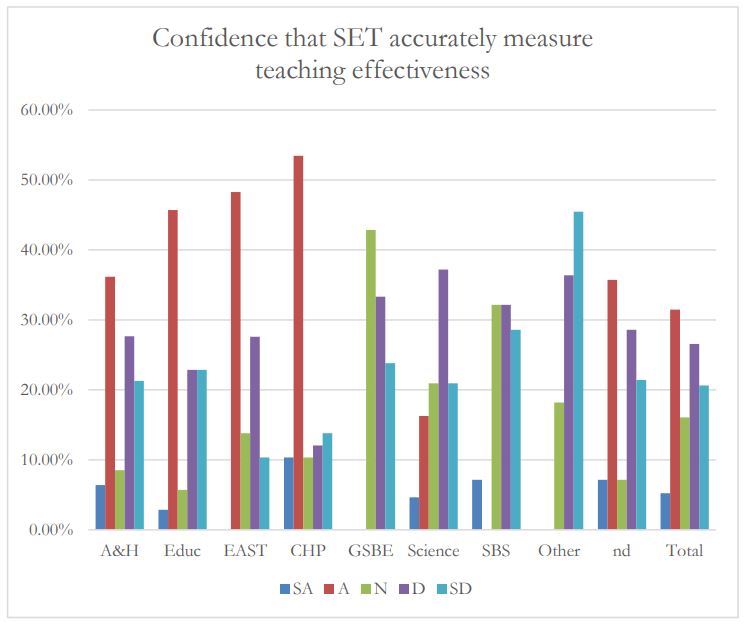
- Overall, 43.71% of respondents agree or strongly agree that SET is an accurate means of measuring teaching effectiveness. Those who disagree or strongly disagree with that statement represent 47.2% of respondents. The remainder – 9.1% - neither agree nor disagree.
- We see a marked difference between colleges on this question with Colleges who have external accreditation requirements, which require student evaluations being more positive in their responses.
- Question 2. Student evaluations of teaching are used appropriately in the promotion process.
Question 3. Student evaluations of teaching are used appropriately in the tenure process.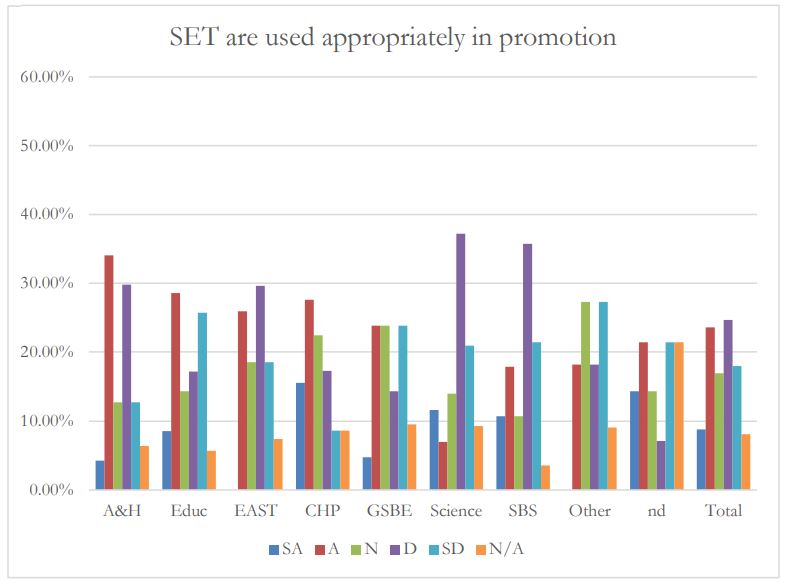
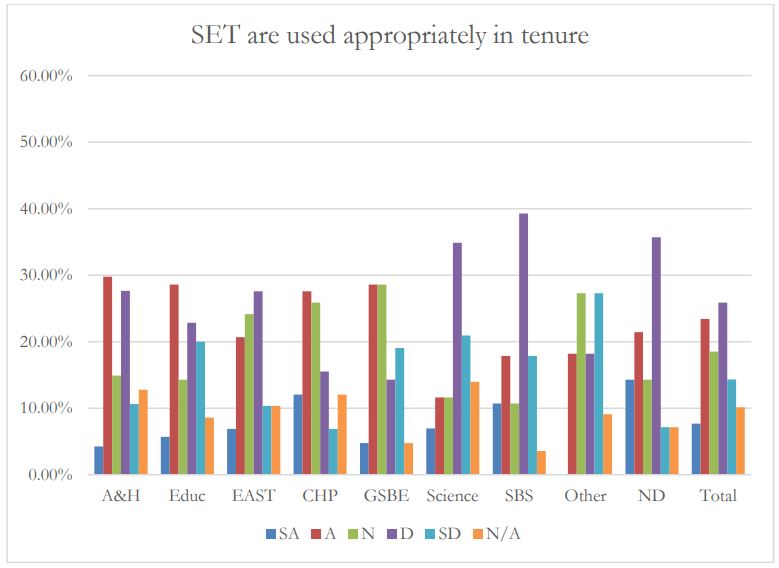
- Overall, faculty in every College were less supportive with how student evaluations were currently being used to evaluating teaching for tenure and promotion
- The survey included three open-ended questions about student evaluations of teaching:
- What are the strengths of the current student evaluation process?
- What are the limitations of the current student evaluation process?
- Please provide any additional feedback and comments about student evaluations of teaching.
- Responses were initially scanned, then reviewed more closely for tagging with categories – a disassembly process. Those categories of responses were then examined for significant themes – a reassembly process.
- There were 177 total responses for this prompt. Strengths with the current process were articulated in 144 of those, and 29 participants received negative responses.
- Findings
- Providing students with a voice (n=38, 38/177 = 21.5%)
- Value/role of Feedback (n=48, 48/177 = 27.1%); primarily focused on the qualitative feedback from students
- 29 participants received negative responses; the majority of those indicating the respondent felt there was no value in the current process:
Background Continued:
The faculty appointed senate task force, which reports directly has met bi-monthly, has done extensive benchmarking regarding good practice related to (1) evaluation effectiveness; (2) the timing/process of student evaluations; and (survey instruments). Several research articles and survey instruments from peer institutions/national institutions were reviewed.
Proposals:
- APAFT will work this year to review and make recommendations regarding how student evaluation of faculty are used in the tenure and promotion process
- Review and make recommendations regarding the timing of student evaluations at WSU:
- Surveys to be administered online
- Traditional Semesters
- Survey will be administered just following the withdrawal period (approximately week 11 of the semester). This ensures that students who withdrew from a course cannot complete the evaluation. Evaluations will remain open for two weeks to capture online students and individuals coming to campus less often and to potentially improve response rates. Run the evaluations from 12:00am to 11:59pm
- Blocks/Exceptions
- Opens on week 6 for one week and closes on week 7 (after the withdrawal period). Run the evaluations from 12:00am to 11:59pm
- Student Evaluation Marketing “Blitz” – Provost’s office will support a marketing blitz. An evaluation week to remind student of the intent/purpose of students evaluations, increase awareness, meaning, and completion of evaluations.
- Signs, QR codes, emails, screens.
- Develop an evidence-based (brief) evaluation survey instrument for use across Colleges, which Colleges and Departments may certainly add to for accreditation and faculty purposes.
Summary of Timing Student Evaluations (Estelami):
" The results indicate that there are significant differences between those students who respond early to survey invitations and those who respond late. Early responders and late responders reflect different segments of the student body, have different course evaluation formation dynamics, and exhibit different grade expectations. The findings suggest the existence of systematic biases in SET scores related to response rate, requiring educators to closely examine policies related to the timing of SET survey administration." Early responders provide feedback about the course experience, late responders reflect on their grade (anticipated or earned) other than the course itself.
Impact of a final exam on student responses (Arnold):
"A special feature of the data is that students were able to complete on-line questionnaires during a time window ranging from one week before to one week after the final examination. This allows for the isolation of the effect of the examination on student evaluations. Among students who subsequently pass the exam, we find little difference between pre-and post-exam ratings. Among students who fail, evaluation scores are significantly lower after the exam on a number of items. Our evidence is compatible with a self-serving bias in student evaluations, but does not indicate that students seek revenge on instructors through lower ratings." My emphasis added.
References (not an exclusive list)
American Sociological Association (2019). Statement on student evaluations of teaching. Arnold, I. J. M. (2009). Do examinations influence student evaluations? International Journal of Educational Research, 48(4), 215-224. doi:https://doi.org/10.1016/j.ijer.2009.10.001
Berrett, D. (2015). Can the student course evaluation be redeemed? The Chronicle of Higher Education
Dmitriy V. Chulkov Jason Van Alstine, (2012). Challenges in designing student teaching evaluations in a business program. International Journal of Educational Management, 26(2),162 – 174.
Estelami, H. (2015). The Effects of Survey Timing on Student Evaluation of Teaching Measures Obtained Using Online Surveys. Journal of Marketing Education, 37(1), 54-64. doi:10.1177/0273475314552324
Hancock, G., D. Shannon, and L. Trentham. Student and Teacher Gender in Ratings of University Faculty: Results from Five Colleges of Study. Journal of Personnel Evaluation in Education 6:235-248, 1993.Wallisch, P., and J. Cachia. 2019. “Determinants of perceived teaching quality: The role of divergent interpretations of expectations.” 10.31234/osf.io/dsvgq
James S. Pounder, (2007). Is student evaluation of teaching worthwhile. Quality Assurance in Education, 15(2), 178 – 191. retrieved from: http://dx.doi.org/10.1108/09684880710748938
Stephen L. Wright & Michael A. Jenkins-Guarnieri (2012) Student evaluations of teaching: combining the meta-analyses and demonstrating further evidence for effective use. Assessment & Evaluation in Higher Education, 37:6, 683-699,
Supiano, B. (2019). A university overhauled its course evaluation to get better feedback. Here’s what changed. The Chronical of Higher Education.
Wallisch, P. and J. Cachia. 2019. “Determinants of perceived teaching quality: The role of divergent interpretations of expectations.” 10.31234/osf.io/dsvgq
Wright, S. L. & M. A. Jenkins-Guarnieri, Student evaluations of teaching: Combining the meta-analyses and demonstrating further evidence for effective use, Assessment & Evaluation in Higher Education, 37(6) 683-699, (2012).
Survey Instruments Reviewed
- Southern Utah University
- Utah Valley University
- Daytona
- Oregeon
- USC
- Question 1. I am confident that current student evaluations of teaching accurately measure my teaching effectiveness.
- Merit Pay Guidelines - MAR 2021
(Faculty Senate Approved March 18, 2021)
SBBFP: Merit pay Document – 2/8/2021
Objective
Develop shared elements of a merit based compensation system for faculty at WSU that focus on transparency and best practices among all academic units
History
Faculty salary increases are usually decided by the Utah State legislature that allocates a certain percentage (say 3%) for salary increases (in past years WSU has sometimes increased this percentage). The SBBFP (Salary, Benefits, Budget, and Fiscal Planning) committee of the faculty senate nominates a negotiation team that recommends allocation of the 3% across two dimensions, an across-the-board (cost-of-living) increase of say 2%, and a merit component of say 1%, to the administration. For the past 3 years, the SBBFP has conducted a faculty survey in order to find out faculty preferences with regard to the two dimensions (cost-of-living versus merit). A majority of faculty (about 70%) have consistently indicated that they would like merit pay, but divergent practices and outcomes across colleges have caused concerns among faculty.
Problem
The allocation of merit pay (pay for performance) requires an annual review of faculty that follows a set of criteria. If the reviews do not distinguish among faculty performance, merit pay will look just like an across the board raise for everybody.
ASSUMPTIONS:
- Faculty differ in their performance
- Performance differentials are significant and can be linked to clear criteria
- Faculty preference for merit pay indicates a desire for some variability in the final salary increases (historically given as a % of salary).
For example, some faculty may receive a 2% raise (using the example from before), while other faculty may see salary increases that are above the allocated 3% increase. Caveats: In a unit with uniformly high performers, all faculty may receive a 3% increase depending on the budgeting model used. The actual degree of variability will depend on the budgeting model, for example whether salary funds are allocated on a college level, department level or university level.
To achieve some degree of variability in salary increases (in %), the SBBFP has discussed some common elements in terms of rating faculty and some possible minimum criteria.
SUGGESTED COMMON ELEMENTS:
Rating system
Based on completion of Annual Faculty Report (AFR) form (differentiated by College), department chairs rate each faculty member exclusively on three categories: 1. Teaching, 2. Scholarship/Creative Productions, and 3. Administration and/or Professional Service – with some consideration on the weights that each category has. For merit pay no other categories are included in the rating (e.g. professional conduct). Faculty ratings in each category follow the language that is used for staff (PREP system). For example, the ratings may be: Does Not Meet Expectations, Meets Expectations, Exceeds Expectations. This language is meant to distinguish decisions regarding merit pay from ratings that are given in the process of rank and tenure decisions.
Minimum channels for merit pay increases
Colleges will be transparent with regard to minimum criteria or channels for merit pay eligibility. However, faculty who have not completed the AFR are not eligible for merit pay in any academic unit.
Format of the Annual Faculty Report form
While the specific format of the reporting should be left up to individual colleges, all forms should allow for multi-year reporting (at a minimum in the scholarship/creative productions category) and the data collection process should be simple. Reporting requirements should not go beyond bullet points in a stream-lined AFR.
Role of the department chair:
- Collect AFR for each faculty member in the department
- Review the AFR
- Assign ratings (possibly in conjunction with the Dean) and communicate ratings to each faculty member and to the Dean’s Council of the college.
- Consider a process where faculty accept/sign-off on the evaluation (similar to PREP) with an opportunity to discuss/contest the ratings.
Role of the Dean:
- Develop a college-wide AFR in collaboration with department chairs (with additional input from other stakeholders as needed) and possible weights or minimum channels for criteria to encourage consistency of ratings.
- Ensure comparable practices of review/rating across all departmental colleges.
- Communicate the range of salary increases (in %) for the college (e.g. to SBBFP, college faculty) and inform individual faculty of their salary increase for the coming year.
Role of the Provost:
- Devise appropriate training for Deans and department chairs (including data on existing salary structure and implicit bias concerns)
- Ensure comparable practices of review/rating across all colleges (decision on whether budgets are allocated to colleges, departments or university wide).
- TLC Vice Chair Position - 2022
(Approved by Faculty Senate February 10, 2022)
Vice-Chair Position in the Teaching and Learning Committee
Each spring semester the Faculty Senate Executive Committee will appoint both a Chair and Vice-Chair of the Teaching and Learning (TLC) Committee unless TLC committee membership requests a different leadership structure. If either the Chair or the ViceChair ceases to be a member of the Teaching and Learning Committee, the Faculty Senate Executive Committee will promptly appoint a successor. The Vice-Chair will shadow and assist the Chair, in order to prepare to serve as a future TLC Chair, and maintain continuity.
General Education
- General Education Area Committees - 2019
(Approved & Revised by Faculty Senate March 24, 2011)
Updated by GEIAC 10/30/2019
UNIVERSITY GENERAL EDUCATION IMPROVEMENT & ASSESSMENT
COMMITTEE PROPOSAL TO FACULTY SENATE:
CREATION OF GE AREA COMMITTEESOctober 2019
As per PPM 1-13, Article B-V, 4.6, the General Education Improvement & Assessment Committee (GEIAC) “shall articulate the mission and goals for the General Education program and University core requirements, and review these on a regular basis. The General Education Committee shall define the standards for the General Education program and oversee the assessment of the General Education program and University core requirements.”
Proposal
To serve its mission, GEIAC proposes the creation of five (5) ad-hoc General Education (GE) Core Area Committees (Composition, American Institutions, Quantitative Literacy, Information Literacy, and Diversity) and five (5) ad-hoc GE Breadth Area Committees (Humanities, Creative Arts, Social Sciences, Physical Sciences, and Life Sciences) to serve as an interface between GEIAC and the many departments which offer General Education courses. The ad-hoc status of the committees means that there will be a designated chair, but the committee members will be identified by chairs of departments in the areas (whom may either review the materials and provide feedback themselves or he/she may assign it to one of their faculty members who has expertise in the requested area), in response to a specific request from the GE Area Committee chair to perform a given function. As GEIAC is now composed of representatives from each Core and Breadth area, the chair of a GE Area Committee will be the GEIAC member(s) [in some instances, there may be Area Committee co-Chairs] representing that Core or Breadth area.
Proposed charge to GE Area Committees
GE Area Committees are charged to:
- Periodically review the area learning outcomes (ALO) and if necessary, propose changes in line with R470 which must be approved by GEIAC, University Curriculum Committee, Faculty Senate Executive Committee, and Faculty Senate.
- Review proposed or already existing courses for which a faculty member is requesting a Gen Ed attribute. The chair should report to GEIAC on the feedback from the Area Committee.
- Provide feedback on assessments of Gen Ed area courses, if requested by GEIAC.
The three charges assure that Gen Ed ALOs, which are outlined in Regents Policy R470, are subject to faculty oversight in how they are defined, assessed, and reviewed for new and existing GE courses in that area. The periodic review of ALOs may be triggered by changes in the R470 or by requests of department(s) that offer courses in the area. The GEIAC chair will decide whether a review of area outcomes is timely and appropriate. The GE Area Committee chair will be responsible for working with area department chairs to constitute a committee (See GE Area Committee Composition) and vote on acceptable changes. GEIAC will review the recommended changes that have a majority of support in the GE Area Committee and vote to either recommend or not recommend changes to University Curriculum Committee (UCC), who in turn will vote to reject the changes or approve and forward them to Faculty Senate Executive and Faculty Senate.
Proposed or existing Gen Ed courses for which a faculty member is seeking to add a Gen Ed attribute, including WSU courses, will be reviewed by the relevant GE Area Committee(s). The committee(s) will be constituted by the GEIAC member(s) who represent(s) the area(s) for which Gen Ed attribute(s) are being sought, in consultation with relevant department chairs. The goal of the review will be to provide feedback to those proposing the Gen Ed attribute about whether course assessments adequately measure the ALOs and GELOs. The GE Area Committee Chair will report to GEIAC about the status of the GE Area Committee review. GEIAC will vote to either recommend or not recommend the proposal to UCC, who in turn will vote whether to approve and send the proposal to Faculty Senate Executive and Faculty Senate.
Departments or programs regularly collect and biennially report assessment data on Gen Ed courses they offer. GEIAC will review those reports (see CPPM 1.3). A GEIAC representative serving as a GE Area Committee chair will request Area Committee feedback on a given course assessment if the GEIAC chair determines that sufficient concerns are raised about whether the assessment adequately aligns with ALOs. These concerns may be raised by other GEIAC members or other faculty or departments teaching in the Gen Ed area.
GE Area Committee Composition
Each GE Area Committee should have
- One GE Area Chair who is a faculty member from a department that offers a GE course in that area, and serves as a member of GEIAC.
- No fewer than 3 additional faculty members drawn from departments that offer a GE course in that area. If an area includes only one department (e.g., COMP, QL, IL) the committee should be composed of two additional faculty from the department and one faculty from any department that offers a Gen Ed course. The GEIAC Chair will approve the composition of an ad-hoc area committee, although the formation will be the responsibility of the GEIAC committee member serving as GE Area Chair
Closing remarks
Having GEIAC members serve as chairs of ad-hoc GE Area Committees ensures greater oversight, improved communication, and less organizational complexity between GEIAC and faculty who teach diverse core and breadth courses. Area chairs will be able to bring GE Area Committees together only when necessary and composing them of faculty best equipped to address the issue, making general education administration more responsive and efficient.
Approved and Submitted by:
Current composition of GEIAC (October 2019)Molly Sween – SBS (SS): GEIAC Chair
C. David Walters – S (QL) (on sabbatical Fall 2019, current replacement Shawn Broderick)
Daniel Jonas – A&H (CA) Matthew Romaniello – SBS (AI)
Brock Adams – EAST
Alvaro La Parra Peres – B&E (AI, SS)
Kiley Spirito – S (PS)
Rieneke Holman – HP
Chris Hoagstrom – S (LS) (on sabbatical Fall 2019, current replacement Craig Oberg
Miranda Kispert – LIB (IL) Jenny Turley – ED (LS)
Becky Marchant – A&H (HU) - WSU Permanency and MOU - MAR 2021
(Approved by Faculty Senate March 18, 2021)
WSU Program
Description
In light of concerns about how General Education was structured at Weber State University, the General Education Improvement and Assessment Committee (GEIAC) created a new category of courses with a course designation of WSU. WSU courses are lower-division classes that fulfill multiple Gen Ed requirements by addressing a topic in an interdisciplinary manner.
There are 28 possible WSU courses, which are all possible pairs of core (QL, AI, COMP) and breadth (PS, LS, SS, CA, HU) Gen Ed requirements. The Registrar worked out the coding of such courses so that WSU course numbers designate the two particular core and/or breath requirements being fulfilled.
Mission
As part of the Weber State University General Education program, WSU courses pose big questions that address significant issues about the world and help students apply their thinking and develop personal and social responsibility, which is demonstrated through signature assignments. The purpose of the WSU Program is to provide students access to unique, team taught, high-impact, interdisciplinary courses aligned with the General Education program outcomes.
Procedures
- Course Structure
- WSU courses are lower-division classes that address a topic in an interdisciplinary manner and are not merely survey-style introductions to a discipline. By uniquely integrating two disciplinary areas, WSU courses fulfill two General Education (core or breadth) requirements.
- WSU courses are committed to High Impact Educational Experiences. To fulfill that commitment, course delivery modalities are limited to Face-to-Face or 50% or higher Face-to-Face Hybrid. Course enrollment is limited to 20–40 students. Any exceptions will need to receive approval from the WSU Advisory Committee (see below).
- WSU course proposals requesting an exception to the course delivery modality and/or max enrollment must include recommendations from the GE areas impacted by the course.
- Exception proposals will be reviewed by the department chairs in the relevant GE areas.
- After receiving feedback from relevant department chairs, GE Area Committee members will vote on the exception proposals.
- A ⅔ majority (with at least 50% of chairs voting) is required to approve exception proposals.
- For single department Gen Ed Area Committees (i.e., QL and COMP), the individual department chair will have to approve.
- WSU course proposals requesting an exception to the course delivery modality and/or max enrollment must include recommendations from the GE areas impacted by the course.
- As with all General Education courses, each WSU course must be framed around a Big Question (BQ), that is tapped in some way by a Signature Assignment (SA). The SA must be deliberate in its integration of the two areas of focus in the WSU course. Instructors for these courses must take special care to ensure the SA addresses GELO 4, Connected and Applied Learning.
- WSU courses must address and have course assessments aligned with both sets of area learning outcomes (ALOs) underlying the course.
- Course Proposals and Approval
- Instructors seeking to teach a WSU course are invited to apply each fall semester to be approved for the following academic year.
- The WSU course application process requires that Instructors provide a justification for the course, describe its uniqueness in the curriculum, and create a syllabus with details of the course content, assessments, and student learning outcomes.
- WSU course proposals are first reviewed by the two GE Area Committees addressed by the course for their adequacy in assessing and achieving the respective GE ALOs.
- WSU course proposals are then reviewed and approved by the General Education Improvement and Assessment Committee (GEIAC) for their interdisciplinary nature and alignment to the respective ALOs.
- WSU course proposals are finally reviewed and approved by the University Curriculum Committee for their overall quality and fit in the curriculum.
- Instructors
- Instructors teaching WSU courses must have expertise in the course content.
- Instructors are expected to be present in all classes.
- Instructors will be responsible for assessment aligned to course outcomes.
- Memorandum of Understanding (MOU)
- MOUs will be completed between the Director of General Education, the Instructors, and their respective Department Chairs for each WSU course.
- MOUs specify the following:
- Instructor Responsibilities
- Director of General Education Responsibilities
- Departmental approval for inload teaching
- Payment Structure
- Contributions to Student Completion of General Education
- Students may take multiple WSU courses, but only non-overlapping GE attributes from subsequent courses will count towards GE requirements.
- Organization and Oversight
- A WSU Advisory Committee consisting of voting members of GEIAC will be responsible for WSU course oversight. The WSU Advisory Committee will:
- Review WSU courses proposals.
- Review exception proposals that change course delivery modality and/or max course enrollments.
- Work with the Director of General Education to make the final decision on any exception proposals.
- The Director of General Education is responsible for administration of the WSU program, including:
- Scheduling WSU courses each year, while attending to the distribution of Gen Ed attributes offered in WSU courses in a given year and balancing old and new WSU course offerings.
- Reviewing WSU course evaluations
- Working with the Office of Institutional Effectiveness to review course assessment data on ALOs and Signature Assignments for GELOs.
- Draft a yearly report on the WSU Program to the WSU Advisory Committee, who will review, affirm, finalize, and include this report in the yearly GEIAC report to the Faculty Senate.
- A WSU Advisory Committee consisting of voting members of GEIAC will be responsible for WSU course oversight. The WSU Advisory Committee will:
- Funding Structure
- The Office of the Provost will provide primary funds for WSU courses.
- WSU courses will be funded at full load for each instructor.
- Payment will be based on credit hours (not SCHs or per head), and can either be paid as overload directly to instructors or to the instructors’ departments if taught in-load.
- The Office of the Provost will provide primary funds for WSU courses.
(Approved by Faculty Senate March 18, 2021)
Memorandum of Understanding (MOU) for WSU Courses
Created by DGE & GEIAC (2021)
Subject
This MOU defines and clarifies the roles and responsibilities of both instructors teaching a WSU course and the Director of General Education (DGE) in a given semester.
Description
As part of the Weber State University General Education program, WSU courses pose big questions that address significant issues about the world and help students apply their thinking and develop personal and social responsibility, which is demonstrated through signature assignments. The purpose of the WSU Program is to provide students access to unique, team-taught, high-impact, interdisciplinary courses aligned with the General Education program outcomes.
Students may take multiple WSU courses, but only the non-overlapping Gen Ed attributes from subsequent courses will count toward Gen Ed requirements.
Course, Course Approvals and Funding
- The MOU applies to WSU ______ (__ Credits, CRN: _______), titled ___________________, to be taught by the “course instructors.”
- The course instructors affirm that the arrangements for teaching the WSU course have been approved by their Department Chair or Program Director and will be scheduled by the Director of General Education (see Terms).
- Course instructors will receive either in-load or overload credit for teaching the course.
- If being taught for in-load credit, the instructors’ departments will be compensated at the rate of adjunct wage to make the department whole.
- Name of instructor(s) earning in-load credit:
____________________________________________________________
- Name of instructor(s) earning in-load credit:
- If being taught for overload credit, the instructor will be compensated at the rate of per credit hour adjunct wage.
- Name of instructor(s) earning overload credit:
____________________________________________________________
- Name of instructor(s) earning overload credit:
- If being taught for in-load credit, the instructors’ departments will be compensated at the rate of adjunct wage to make the department whole.
Terms of the Agreement
Instructors
- WSU courses are committed to High Impact Educational Experiences. To fulfill that commitment, course delivery modalities are limited to Face-to-Face or 50% or higher Faceto-Face Hybrid.
- Enrollment in WSU courses is limited to one section, 20–40 students.
- Any exceptions to course delivery modality and/or max enrollment need to receive approval from the WSU Advisory Committee.
- Instructors teaching WSU courses must have expertise in course content and are expected to be present at and participate in all class periods.
- WSU courses must be framed around a Big Question (BQ) that is stated in the course syllabus. The BQ should tap into the heart of both disciplines and help students see what they can do with what they are learning.
- WSU courses must include a Signature Assignment (SA) that is labeled as “Signature Assignment” in Canvas. The SA must be deliberate in its integration of the two areas of focus in the WSU course. Instructors for these courses must take special care to ensure the SA addresses GELO 4 (Connected and Applied Learning).
- WSU courses must address and have course assessments aligned with both sets of area learning outcomes (ALOs) underlying the course (e.g., a WSU course with SS and LS attributes must address all three SS and all eight LS learning outcomes).
- Instructors teaching WSU courses must provide the DGE with their course assessment data in the provided rubric within 4–6 weeks of the end of the semester.
- Instructors teaching WSU courses are responsible for handling their own textbook orders with the Weber State Bookstore.
Director of General Education (DGE)
- The DGE will work with the course instructors to determine the day/time the course will be offered.
- The DGE will work with relevant staff to find classroom space for the WSU course.
- The DGE will provide the course instructors with their CRN once assigned.
- The DGE will review WSU course evaluations and discuss any necessary feedback with the instructors to ensure the courses provide high quality, high impact educational experiences.
- The DGE will receive course assessment data in the provided rubric on all course area learning outcomes. The DGE will work with the Office of Institutional Effectiveness to review assessment data, including Signature Assignments, to assess the GELOs.
MOU Duration
This memorandum will be valid for the academic year ______________
Parties to the Agreement
- Director of General Education, Dr. Leigh A. Shaw
- Course Instructors
Signatures
__________________________________
Director of General Education, Leigh A. Shaw________________
Date__________________________________
Instructor 1 (name)________________
Date__________________________________
Instructor 2 (name)________________
Date - Course Structure
- DV Hiatus Extension - APR 2021
(Approved By Senate April 8, 2021 )
Requested Extension for Temporary Hiatus on DV Designation
3-25-2021
The General Education Improvement and Assessment Committee (GEIAC) is requesting that the Faculty Senate pass a resolution to extend the temporary hiatus on submissions of General Education courses seeking a new Diversity (DV) designation, to remain in place through fall semester 2021. This is one additional semester to the original hiatus we received for spring 2021. Once the hiatus ends, faculty would be able to submit their course proposals for the DV designation as of spring 2022, which would add the course to the curriculum for the following calendar year (AY 2022-23).
It is difficult, if not impossible, to work toward revising the current DV outcomes while also reviewing courses that are seeking a new DV designation. We have made significant progress in revising the current DV outcomes and are actively in the process of vetting these changes among campus stakeholders. We anticipate this work will be completed in summer 2021. We intend to submit a proposal for approving those changes with the University Curriculum Committee and the Faculty Senate in fall 2021. Rather than have courses arrive that would immediately need to rethink their structure to accommodate the new outcomes, it would be better to pause these submissions for the next semester while GEIAC, UCC, and the Faculty Senate complete their work. Extending the current semester-long hiatus from new DV proposals through fall semester will be more efficient for faculty seeking to include Diversity topics in their courses.
Since we are in the final stages of completing our work on this revision, we have every confidence our proposal will be ready for the Senate’s review in fall 2021. Courses could once again seek approval for their DV designation by spring semester 2022.
Sincerely
GEIAC Committee (Spring 2021)
Chair, Molly Sween