
Video Walkthroughs
Atomic Force Microscope
This video will provide an overview and walkthrough the basic operations of the Atomic Force Microscope (AFM) at Weber State University in the College of Science.
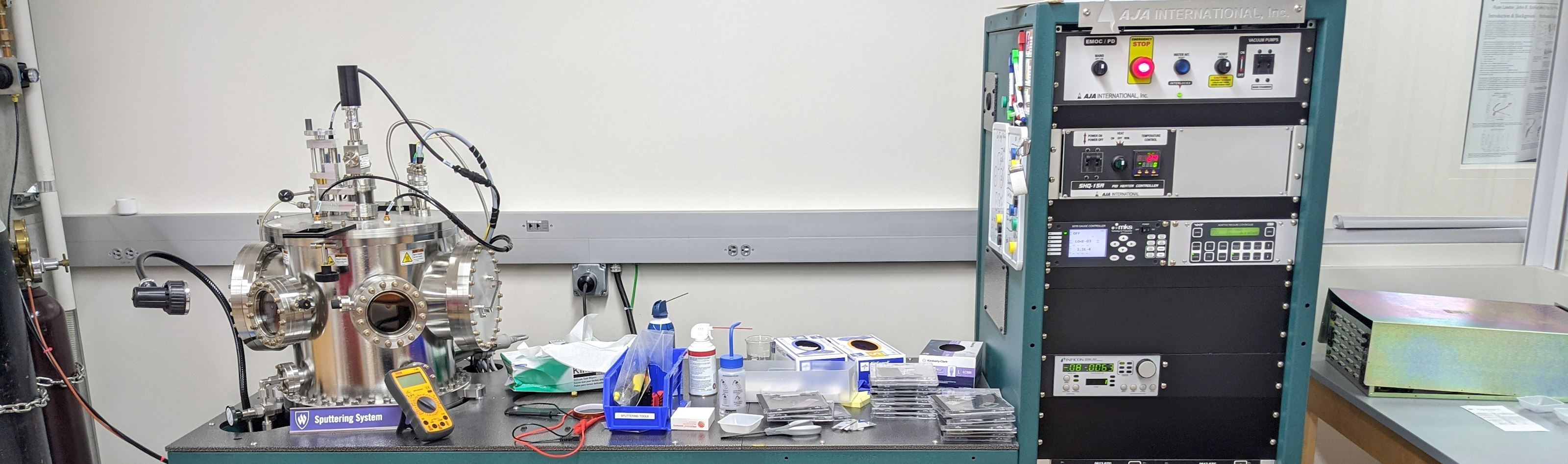
Sputtering System
This video will provide an overview and walkthrough of the basic operations of the AJA ATC-Orion 8 UHV Sputtering System at Weber State University in the College of Science.
X-Ray Diffractometer
This video will provide an overview and walkthrough of the basic operations of the Rigaku XRD at Weber State University in the College of Science.
Carbon Coater
This video will provide an overview and walkthrough of the basic operations of the Quorum Q150T Plus at Weber State University in the College of Science. Carbon coating can be necessary for SEM samples prior to imaging on the SEM to reduce charging effects.
SEM (Scanning Electron Microscope)
This video demonstrates the fundamental operation of the Scanning Electron Microscope (SEM), an essential instrument for high-resolution surface imaging and analysis. Viewers will learn how to load a sample, achieve high vacuum, generate and focus the electron beam, and acquire high-quality images using secondary electron (SE) detectors for topography. Key parameters such as accelerating voltage, spot size, and working distance are explained. This guide is designed for students, researchers, and engineers in materials science, biology, geology, and engineering who are new to electron microscopy at Weber State University.
Cathodoluminescence (CL) Detector for SEM
This video demonstrates an advanced analytical capability of our Scanning Electron Microscope: the Cathodoluminescence (CL) detector. The presentation explains how the CL system captures, filters, and analyzes the faint light (luminescence) emitted from a sample as it is scanned by the SEM's electron beam. The demonstration shows the procedure for engaging the detector, aligning the collection optics, and acquiring spectrally-resolved data. This specialized technique reveals information on crystal defects, impurities, and growth history not visible with other methods.
ICP-MS (Inductively Coupled Plasma - Mass Spectrometry)
This video provides a detailed tutorial on the Inductively Coupled Plasma - Mass Spectrometer (ICP-MS), a powerful analytical technique for ultra-sensitive elemental and isotopic analysis. We demonstrate the process of plasma ignition, sample introduction via a nebulizer, and data acquisition as the mass spectrometer separates ions by their mass-to-charge ratio. The video highlights how to interpret the resulting data to determine elemental concentrations down to parts-per-trillion (ppt) levels. This resource is intended for researchers and students in chemistry, environmental science, and geology.