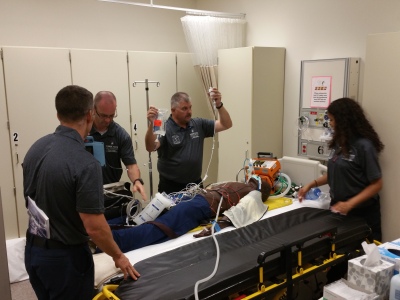
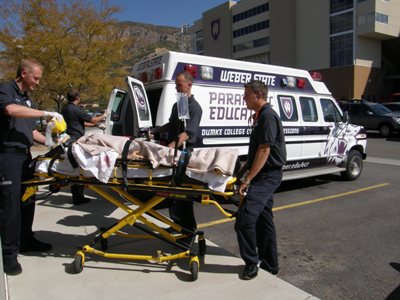
Paramedic Training Offered at Rural Sites
WSU's Department of Emergency Care & Rescue is helping western states train paramedics in rural areas, with a program that uses state-of-the-art interactive video technology to educate students in Utah, Wyoming, Idaho and Washington.
Training responders in rural areas is critical because the need for paramedics is most acute in those places where medical assistance isn't just around the corner. The video technology allows a professor teaching a class at the Ogden campus to interact with 25-30 additional students in these remote areas.The program is NOT intended or designed for "single student - at home or work" delivery.
A "distance ed" site usually consists of 3-5 co-located students outside of Weber and Davis Counties. Students are expected to "collect" designated learning site for each interactive video lecture. Skills are generally done in a "skills camp" model at the Ogden, Utah campus. Due to the fact skills are delivered in an intense fashion, this program is intended for students with solid EMS experience. Dependent upon community resources, a hybrid skills program MAY be developed at a distance ed location to decrease student travel time. Students in Weber and Davis Counties are invited to attend the evening "face-to face" class session on the Ogden Campus.
Starting catalog year 2006-2007, all students must have the following prerequisites with a "C" or better before starting any WSU Paramedic Program:
- EMT or Advanced EMT certification
- Documented MATH 0960 competency
- Documented 2 credits in Medical Terminology
- Documented 3 credits in English 1010
- Documented 8 credits of "matched set" Anatomy and Physiology
- Minimum GPA of 2.7
Class is held on Tuesday and Thursday evenings from 1800-2200. The 16 month, (4 semesters) program starts each fall semester and is subject to minimum student enrollment requirements. Class attendance is mandatory as this program is not provided in an "asynchronous" or "TIVO" format.
More details about the department's distance learning program, including site selection, cost, time commitments and student prerequisites, can be found here: Program Details
Academic Year 2013 - 2014 (Program is being restructured)
- The evening course will take a one year break starting in Fall 2013 for the following considerations:
- The 2010 National EMS Education Standards are now mandatory for all accredited programs. While Weber State has always been ahead of the standards we need to review our day (campus) curriculum for any inadvertent gaps.
- Starting in Fall 2013, the EC&R Department will have two new full-time faculty. It should be noted the campus full time faculty develops and drives the delivery of content/testing to the night course.
- In 2013 we will be implementing a new textbook, Emergency Care in the Streets by Nancy Caroline. This text meets all the requirements of the 2010 National EMS Education Standards, however, we need to review all teaching resources, build online materials and revise current tests.
- Lastly, in 2012, all Utah Schools of Higher Education (USHE) switched to the CANVAS learning management system. For Weber State this means the paramedic program has to rebuild into CANVAS all of its online materials that were once used in WebCT.
- Our plans are to re-offer a night and/or distance education version in 2014.